Denver Upholstery Cleaning — Cream Sectional Coffee Stain
Denver Luxury Upholstery Cleaning: How We Saved a $50,000 Cream Sectional
A $50,000 cream sectional. A Denver high-rise on the fifth floor. Coffee stains across the fabric. And no room to bring in extraction equipment. We got it done for $299 — and the building owner asked us back for every unit they own.
The Job: Fifth Floor, Corner Unit, No Equipment Access
The call came from the owner of a $3.5 million Denver apartment. They had a large cream-colored sectional — fabric code W — covered in coffee stains. The couch was too large to move and tucked into a fifth-floor corner unit with no practical access for truck-mounted extraction lines.
We've cleaned $300 couches and $100,000 couches. The fiber chemistry doesn't care about the price tag. What matters is the fabric code, the stain type, and the method.
This one was fabric code W — water-based cleaning only. Cream color means every application shows immediately. Coffee is a tannin stain. Tannin bonds to fiber and sets with heat. We had to work carefully, by hand, the way you'd detail a car — section by section, pass after pass.
What Fabric Code W Means for a Cream Sectional
[Insert Photo 2 here — Care tag showing fabric code W]
Fabric codes determine the cleaning method — not the price of the couch, not the material appearance. The IICRC S300 Upholstery and Fabric Cleaning Standard defines the fabric code system used by every certified upholstery technician.
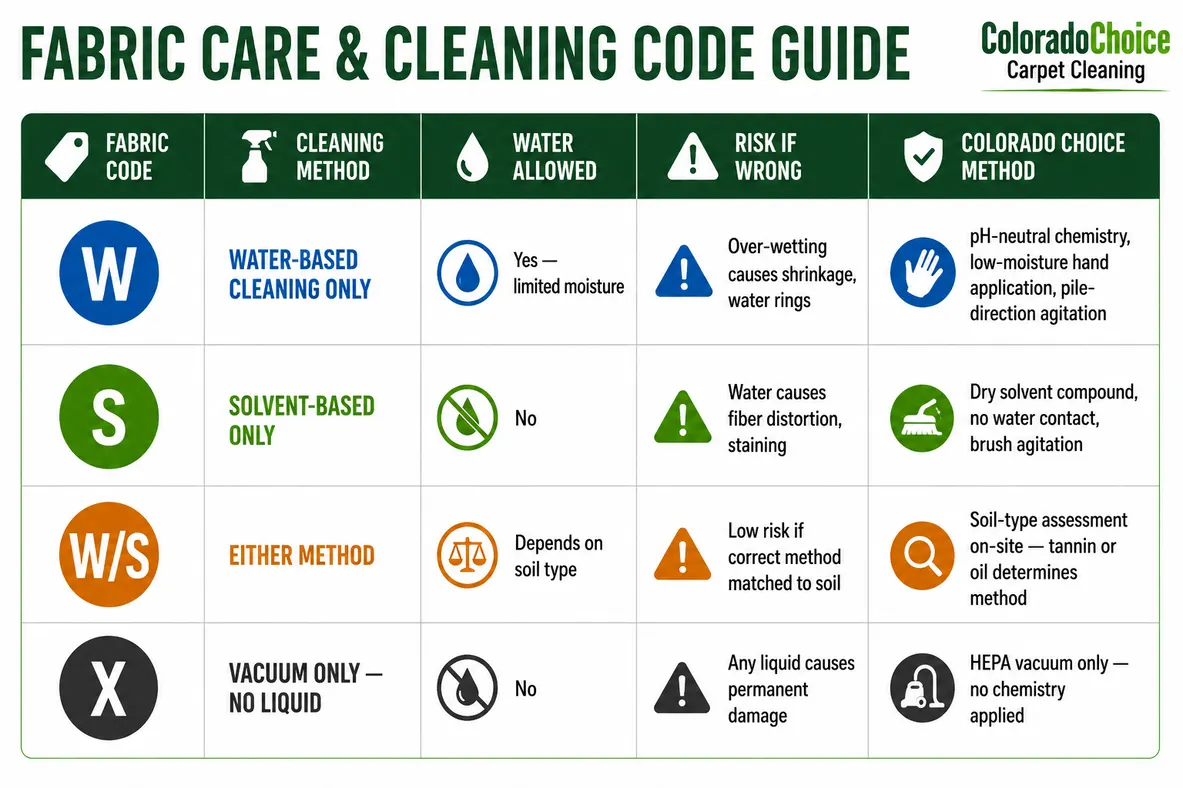
Cream fabric code W requires controlled moisture. Too much water on a light-colored synthetic fiber creates water rings as it dries. We applied chemistry in passes — letting each section respond before moving forward. No flooding. No rushing.
How We Cleaned a Coffee-Stained Cream Sectional by Hand
Coffee stains contain tannins — organic compounds that bond to fiber on contact and darken with heat. The mechanism: tannin molecules carry a slight negative charge that binds to positively charged fiber sites. A mildly alkaline pre-spray at controlled pH (between 7.5 and 8.5) neutralizes that bond without exceeding the fiber's pH tolerance — which on fabric code W synthetics is typically pH 9 before damage begins. Stay below that ceiling, agitate slowly, and the tannin releases. Proper tannin stain removal is one of the highest-skill calls in upholstery work because the pH window is narrow and the visible damage threshold on a cream fabric is immediate.
In a high-rise with no extraction equipment access, the process becomes entirely manual.
Here's what the cleaning sequence looked like:
1. Pre-inspection — Identified all stain locations, tested fabric response in a hidden area, confirmed fabric code W label.
2. pH-neutral alkaline pre-spray — Applied tannin-targeting chemistry at controlled pH (7.5-8.5) to break the coffee bond without approaching the fiber's damage threshold.
3. Hand agitation — Worked each stained section by hand in the direction of the fabric pile, pass after pass.
4. Controlled moisture extraction — Used low-moisture method to lift chemistry and soils without saturating the cushion foam.
5. Air dry inspection— Checked each section as it dried to confirm no water ring formation and complete stain removal.
How We Know This Works
Tannin staining on fabric code W upholstery follows a predictable chemical sequence. The tannin-to-fiber bond is formed through electrostatic attraction — not a covalent bond, which means it is reversible with the correct pH. The window for reversal narrows as the stain ages and as heat is applied (heat accelerates polymerization of the tannin compound into the fiber structure). On this job, the coffee stains were moderately set — not fresh, not heat-locked. That placed them squarely in the recoverable range with mildly alkaline chemistry and controlled agitation.
This is the difference between 23 years of field work and a cleaning rental machine: knowing which stains are chemically reversible, which are not, and exactly where the pH ceiling sits for the fiber you're working on.
Denver's Affordable Choice for High-End Upholstery Cleaning
This job cost $299.
The customer was prepared to spend significantly more — or replace the couch. We cleaned a $50,000 sectional, in a $3.5 million apartment, with full IICRC-certified process, for $299.
That price is possible because Colorado Choice is owner-operated. No franchise royalties. No corporate overhead passed to the customer. The same IICRC certification, the same 23 years of experience, the same process — at a price that makes protecting a valuable piece of furniture an easy decision.
Denver's affordable choice for luxury upholstery cleaning isn't a discount service. It's a direct-to-owner business that doesn't carry the overhead of a franchise.
How We Know Denver Upholstery Cleaning
Denver high-rise units present access challenges that don't exist in single-family homes. No driveway. Elevator logistics. Corner units with no window access. Furniture that can't be moved. Our Denver upholstery cleaning work spans Denver's downtown, Capitol Hill, Cherry Creek, and RiNo corridors.
The building owner who called us owns multiple units in the same building. After seeing the sectional result, they asked us to inspect the upholstery in every unit they own. That referral loop — built on one $299 job — is how a 23-year owner-operated business grows in a city like Denver. Our multi-unit commercial cleaning program is set up for exactly this kind of building-wide engagement.
Frequently Asked Questions
Can coffee stains be fully removed from cream upholstery?
In most cases, yes — when treated correctly. Coffee contains tannins that bond to fiber through electrostatic attraction and respond to mildly alkaline pH-neutral chemistry. The key variables are how long the stain has been set, whether it was treated with heat (which accelerates tannin polymerization into the fiber), and the fabric code. Fabric code W with a fresh or moderately set tannin stain has a high success rate with professional hand cleaning using IICRC S300-compliant methods (IICRC S300 standard). Our full fabric code W cleaning process is built around these chemistry constraints.
Why can't you use truck-mounted equipment in a high-rise?
Truck-mounted extraction equipment requires hose runs from the truck to the unit — typically from the parking area through elevator access and hallways. On upper floors in corner units, that run can exceed practical limits. For high-rise upholstery, hand-method low-moisture cleaning with professional chemistry delivers the same chemical result without the equipment access requirement. We cover this access pattern across our Denver high-rise cleaning work.
How much does upholstery cleaning cost in Denver?
A large sectional like this — fabric code W, multi-piece, high-rise access, professional hand method — was $299 at Colorado Choice. Because we're owner-operated with no franchise royalties, we're able to price accurately for the job without the overhead markup that franchise models carry. Call (720) 730-8055 for a straight quote on your piece.
Call Colorado Choice Carpet Cleaning: (720) 730-8055
