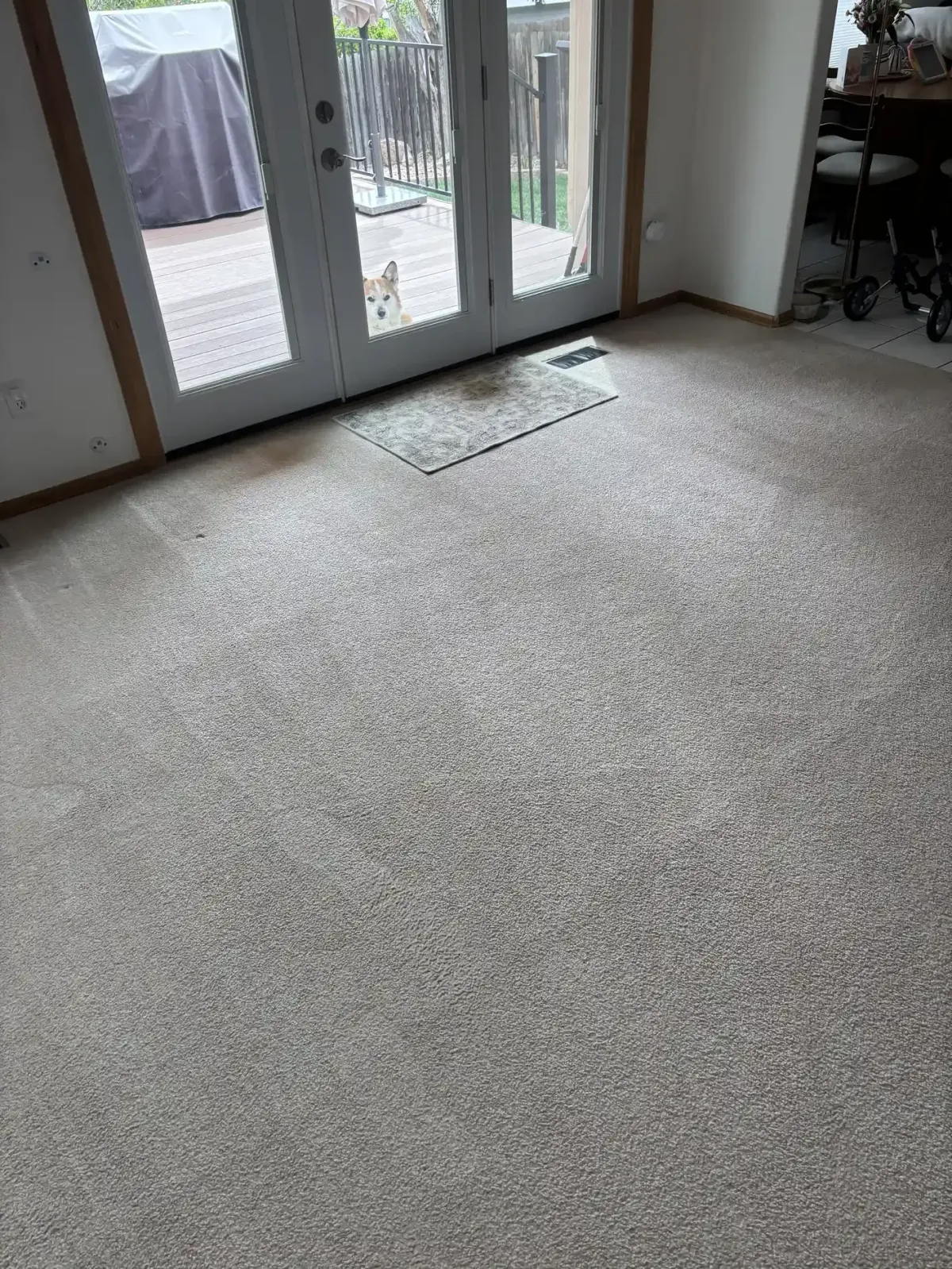
Denver Country Club Wool Wall-to-Wall
Wall-to-Wall Wool in Denver's Country Club Neighborhood — The Spot Report
Some jobs are just different the moment you pull up.
The Denver Country Club neighborhood — historic homes, mature trees lining the streets, properties that have been owned by the same families for generations. This was one of those. We have been cleaning this home for a few years now. The client is a particular woman in the very best sense of that word. She has high standards for her home, and she will not trust it to just anyone. She has a view from her second-floor balcony that is genuinely one of the most stunning in Colorado. And her carpet is not your average wall-to-wall.
It is wool. Wall-to-wall wool.
Why Wall-to-Wall Wool Is in a Different Category Entirely
Most homeowners never encounter wall-to-wall wool carpet. You see it occasionally in very high-end historic homes — properties where the original build spec called for natural fiber throughout, or where a renovation budget had no ceiling. In Denver's Country Club neighborhood, it shows up more than anywhere else we work.
Wool is not forgiving. Unlike the nylon and polyester carpet that fills most homes along the Front Range, wool has a narrow pH tolerance — research published by WoolSafe and referenced throughout the IICRC S100 standard puts it between pH 5 and 8. The natural pH of wool fiber sits around 4.5 to 6.0, meaning it is slightly acidic by nature. The standard alkaline pre-sprays most carpet cleaners use — built for synthetic fiber, typically running pH 9 to 12 — can cause chemical burns on wool. That is not an exaggeration. High alkalinity triggers a reaction that pulls brown tannins to the fiber surface, yellows the pile, and in severe cases begins to break down the fiber structure itself. The damage does not always show up the day of cleaning. It appears days later as the carpet dries, and by then it cannot be reversed. Correct stain and odor removal on natural fiber starts with knowing what chemistry the fiber can actually tolerate.
Then there is the moisture issue. Wool can absorb up to 30 percent of its weight in moisture before it even feels wet to the touch. That means a technician can significantly oversaturate a wool carpet without realizing it. Over-wet wool in a wall-to-wall installation — not a small area rug you can move to a controlled drying environment — creates a shrinkage and felting risk along the edges and seams. Felting is what happens when wet wool fibers agitate against each other under heat or mechanical action. The microscopic scales on each wool fiber shaft interlock when wet and disturbed, matting the pile in a way that no subsequent cleaning process can reverse. You can felt a wool carpet with the wrong tool, the wrong temperature, or simply too much water.
This is why most carpet cleaners either avoid wool entirely or make costly mistakes on it.
Our Protocol for Wool Wall-to-Wall — Low Water, pH-Controlled, No Shortcuts
We clean wool with a low-moisture hot water extraction approach using pH-neutral chemistry throughout — no alkaline pre-sprays, no high-heat oversaturation. Our Prochem Apex GTX truckmount gives us precise control over both water volume and temperature, and on wool we dial both down from where we run on synthetics.
Here is what each step actually involves and why it matters:
Step 1 — Pre-Inspection of the Full Field
Before any chemistry touches the carpet, we walk the entire installation. On wool wall-to-wall we are looking at seam integrity, pile condition, any distortion from prior cleaning attempts, and the backing construction. Wool in older historic homes like this one is frequently backed with jute — a natural plant fiber that absorbs water readily and shrinks as it dries. A jute-backed wool carpet that gets over-wet during cleaning can pull away from the tack strip at the walls as it dries, creating gaps that are expensive to re-stretch and re-seam. Knowing the backing type before we start changes how aggressively we extract in those perimeter zones. We also use this walkthrough to identify any pre-existing fiber stress, color variation, or contamination patterns that need a different approach than the main field.
Step 2 — pH-Neutral Pre-Spray, Verified Before Application
We apply a wool-safe, pH-neutral pre-spray formulated specifically for natural fiber — not reformulated synthetic chemistry with the label changed, but wool-specific chemistry where the pH has been engineered to stay within the 5 to 8 range that wool fiber tolerates. We verify pH before application on every natural fiber job. The pre-spray's job is to suspend soil in the pile so extraction can lift it cleanly. On synthetic carpet, aggressive alkaline pre-sprays at pH 9 to 12 are effective at breaking down heavy oil-based soils and traffic lane buildup. On wool, that same chemistry starts attacking the fiber. The dye system in wool is acid-fixed — meaning the dyes bond to the fiber in an acidic bath during manufacturing. Introduce sustained alkalinity and you begin reversing that bond, which is how you end up with color bleed, browning, and yellowing that the homeowner discovers three days after the cleaner has left.
Step 3 — Reduced Temperature, Controlled Pressure Extraction
Standard hot water extraction on synthetic carpet runs at 200 to 230 degrees Fahrenheit at the truckmount. On wool we reduce temperature substantially. The concern is not fiber melt — wool does not melt the way nylon can under extreme heat. The concern is two-fold. First, elevated heat combined with moisture and any mechanical agitation accelerates the felting risk in the pile. Second, high-temperature repeated passes on a wool dye system can cause gradual color shift over time, particularly in installations with multiple dye lots in the field. We run controlled pressure passes — sufficient to drive the cleaning solution into the pile and extract soil effectively, not enough to drive water deep into the backing and pad where it will sit and create secondary problems. Every pass is deliberate. We are not trying to finish faster.
Step 4 — Immediate Pile Grooming
As soon as extraction is complete, we groom the pile in a single consistent direction. On wool this is not optional finishing work — it is part of the protocol. Wool pile that dries in a disturbed or multi-directional state can set that way permanently. The natural crimp and scale structure of the wool fiber holds whatever position it is in when moisture releases during drying. Grooming immediately after extraction sets the pile correctly, ensures uniform appearance across the full field, and increases surface area exposure to air which accelerates drying time.
Step 5 — Moisture Meter Verification Before We Leave
We check the carpet field, the backing, and the pad with a moisture meter before we pack up. On wool wall-to-wall this step is non-negotiable. Because wool absorbs moisture without feeling wet at the surface, it is entirely possible to finish a job believing the carpet is nearly dry when the backing or pad is still significantly saturated. Elevated moisture held in the backing for more than 24 to 48 hours creates mold germination conditions regardless of fiber type — and on a natural fiber installation in an older Denver home, that window is real. We confirm readings before we leave. If ventilation needs to run longer, we say so before we go.
Visit our wool carpet cleaning service page for a full breakdown of how we approach natural fiber cleaning across the Denver Metro.
The IICRC S100 standard — the industry benchmark for professional carpet cleaning — provides the framework we work within on every job, and wool requires applying that standard with an additional layer of care that most technicians are simply not trained for.
The New Puppy From Mexico
She had been in Mexico for part of the year — she splits time — and came back with a new puppy. Young dog, still getting the routine down, a little skittish in the new environment.
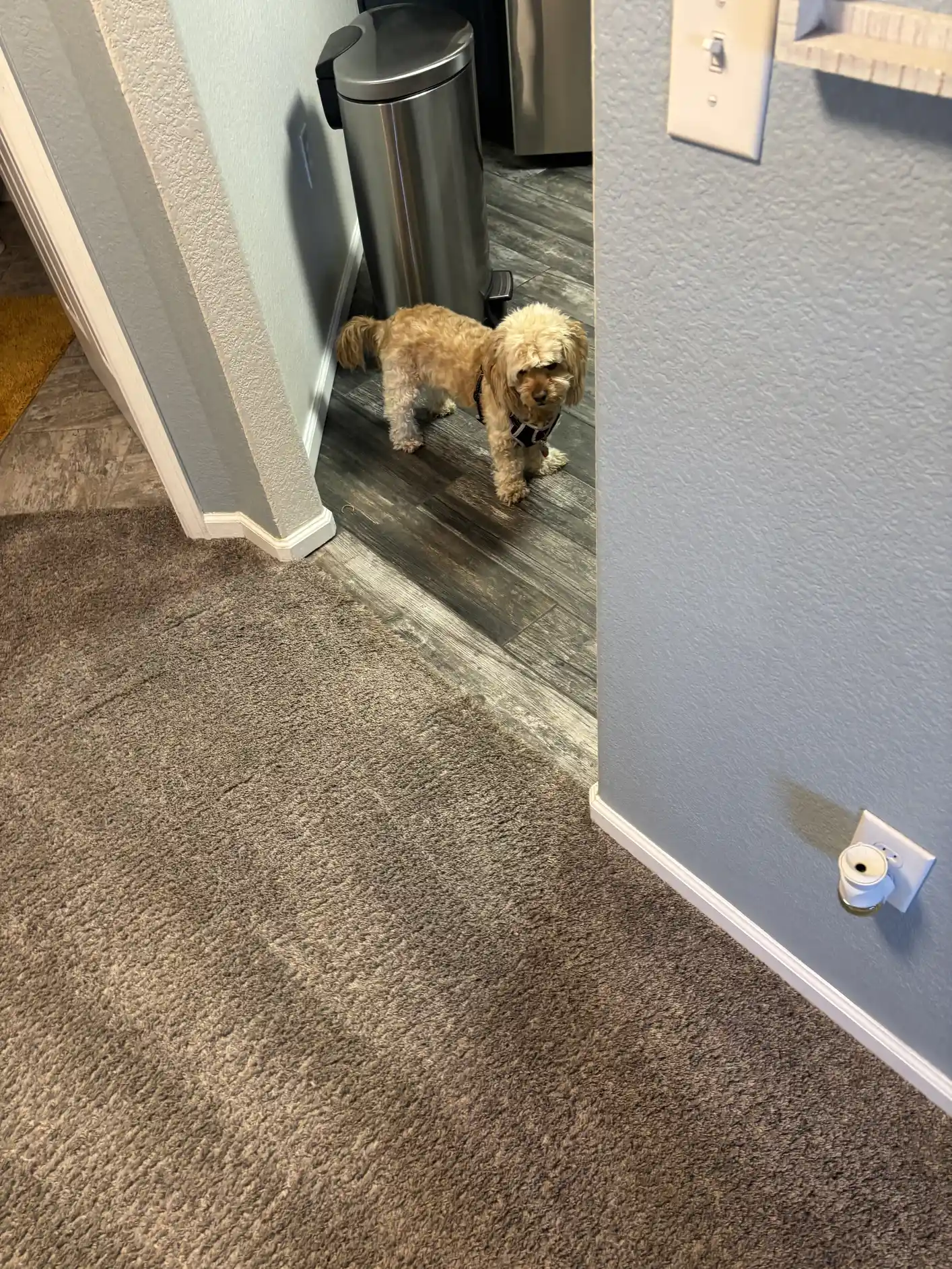
There were two fresh accidents on the wool in the main area we always clean. We have done her basement and stairs for years, and this was our first time dealing with a contamination situation in this room. On wool, fresh pet urine matters more than on synthetic. Wool's absorptive capacity means urine penetrates deeper into the fiber and backing faster than it would on nylon or polyester. With hard water from the Denver Basin aquifer, uric acid crystals also bind differently — the elevated mineral content creates ion competition that reduces the effectiveness of enzyme treatments unless you calibrate the concentration accordingly.
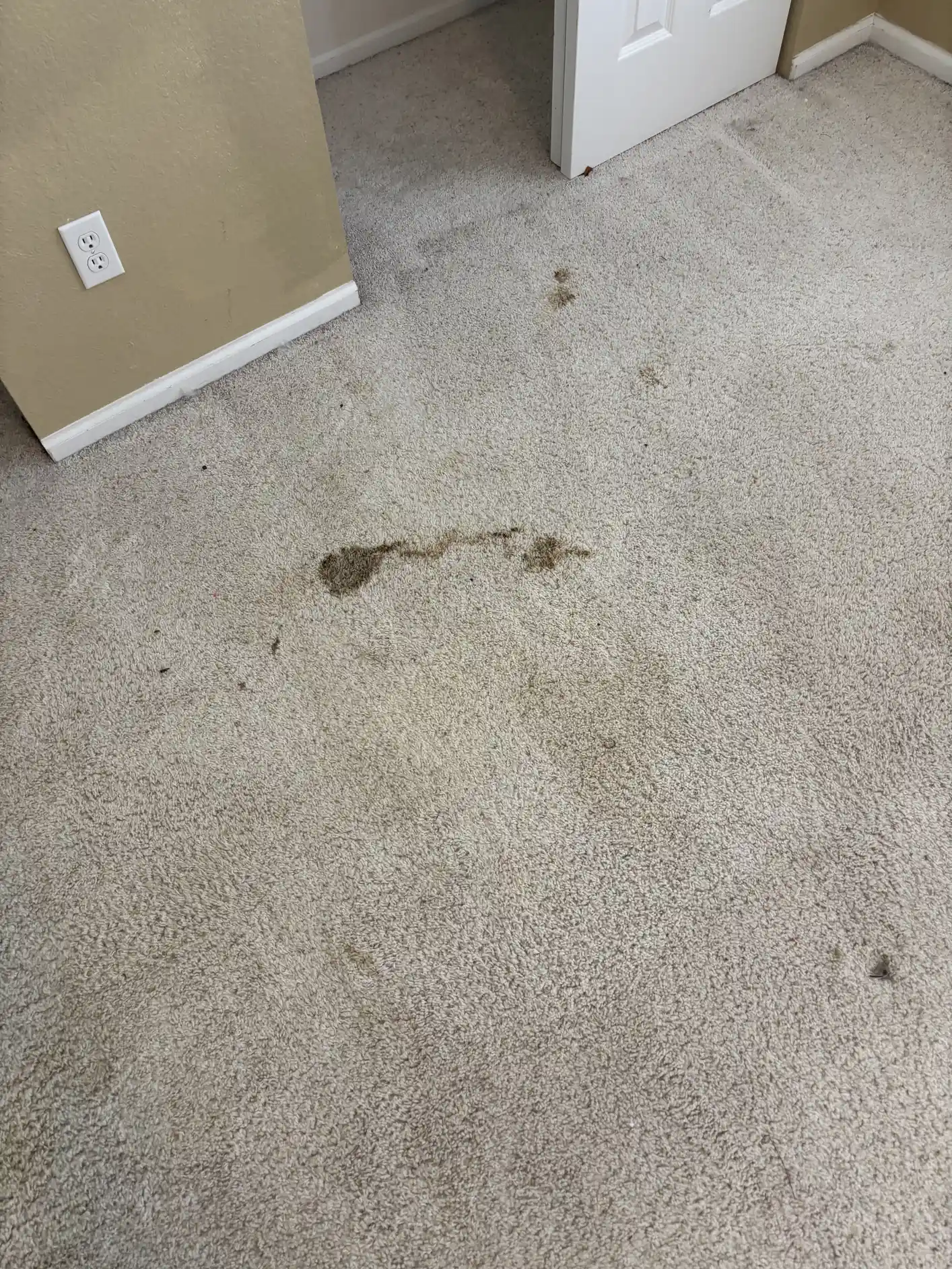
We pre-treated with enzyme chemistry formulated for natural fiber and hard water conditions, gave proper dwell time, and extracted with our low-moisture protocol. Both areas came out completely.
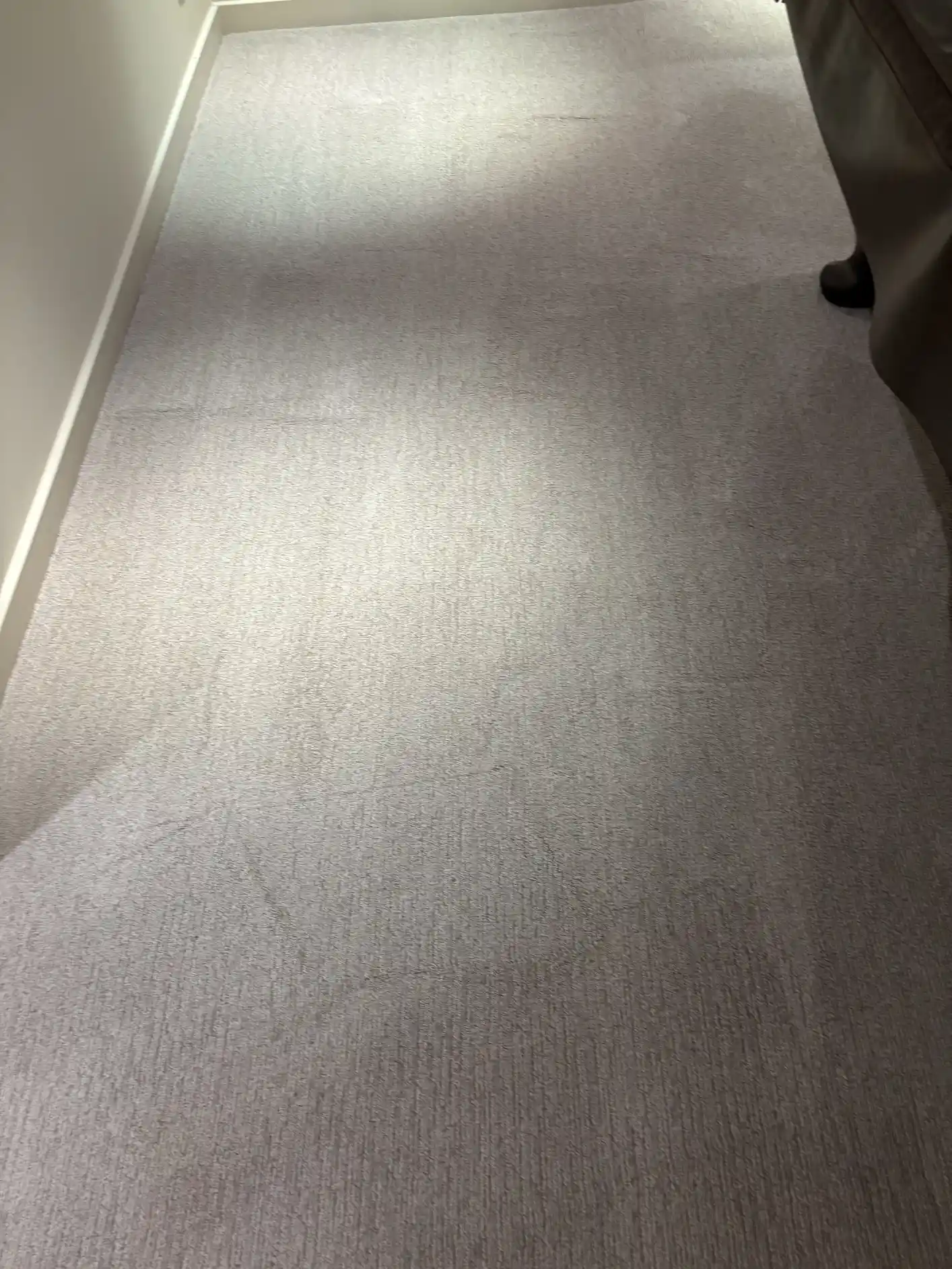
She was happy. Genuinely relieved. A new puppy is a joy. A new puppy on wool wall-to-wall in a historic Denver home is also a little nerve-wracking if you do not have a cleaner you trust.
The Stain Nobody Got Out for Ten Years
Here is the part of this job that stuck with me.
After we finished the main areas, she walked us upstairs. We had never been up there — the rest of her home is hardwood. She brought us to a spot on the wool carpet in an upper room and told us that a carpet cleaner had treated that area roughly ten years ago, before she found us, and they had never gotten it out. She had been looking at it ever since. Prior dog. Prior cleaner. Unresolved stain.
She said — and I appreciated this — that she had never asked us to try it before because she had accepted it was permanent. But she figured, since we were there, it was worth asking.
We got it out.
I cannot always tell you why a stain that resisted treatment ten years ago comes out on a given day. What I can tell you is that the wrong chemistry applied earlier — possibly an alkaline solution on wool, possibly a product that set the stain rather than lifted it, possibly both — can change the fiber chemistry in ways that make subsequent extraction harder. When you come in later with the right pH, the right enzyme chemistry calibrated for Denver's hard water, and a low-moisture protocol that lets you work the area without oversaturating it, sometimes you get an outcome that surprises even the homeowner.
She had not expected it. We had not promised it. It came out anyway.
What This Job Is Really About
Whether you have a $10 million home in the Denver Country Club neighborhood or a three-bedroom rental property anywhere in the Denver Metro area, the job is the same. We bring the same equipment, the same IICRC-certified protocol, the same attention to what is actually in front of us — fiber type, water chemistry, soil profile, contamination history.
A trusting client who will only let us through her door is not a small thing. We do not take that for granted. And when she asked us to try for a stain that had been there for a decade, we gave it the same effort we would give anything else.
That is the job. Every time. Trusted Denver carpet cleaning means doing the work right whether the home is historic or new construction.
Frequently Asked Questions — Wool Carpet Cleaning Denver
Can wool wall-to-wall carpet be professionally cleaned without damaging it?
Yes — but only with the right chemistry and moisture protocol. Wool requires pH-neutral cleaning solutions in the 5 to 8 range and low-moisture extraction. Standard alkaline pre-sprays used on synthetic carpet can cause browning, yellowing, and fiber damage on wool that cannot be reversed. IICRC-certified technicians trained in natural fiber cleaning understand these restrictions and adjust their process accordingly.
Why does pet urine on wool carpet require a different treatment than on synthetic carpet?
Wool's natural fiber structure absorbs moisture more deeply and quickly than nylon or polyester, which means urine penetrates the backing faster. In Denver's hard water environment — sourced from the Denver Basin aquifer — elevated mineral content also affects enzyme chemistry performance, requiring concentration calibration that many standard pet treatment protocols do not account for.
Is it possible to remove a pet stain from wool carpet that was treated incorrectly years ago?
Sometimes, yes. If the original treatment used chemistry that was too alkaline for wool, it may have set the stain or altered the fiber rather than lifting the soil. Approaching the area later with correct pH-neutral chemistry and proper dwell time can sometimes achieve results that the original treatment could not. There are no guarantees, but it is always worth attempting with the right protocol before assuming a stain is permanent.
How We Know Denver's Country Club Neighborhood
I have a personal connection to this part of Denver that goes back further than the business does.
My grandfather was a chef at the Denver Country Club. I grew up with stories about this neighborhood — the homes, the history, the people who have lived there for generations. When I pull up to a job on that street today, it is not my first time understanding what this place means to the people who live here.
We are based out of Castle Rock, and yes — we drive to Denver for jobs like this one. We drive because we have earned the trust of clients in this neighborhood who will not call anyone else. Word travels in a community like the Country Club neighborhood. When one homeowner has a cleaner they trust with wool wall-to-wall, natural stone, and original hardwood, and that cleaner does the job right every time, other homeowners on the same street take notice. We do a lot of work in this part of Denver. That did not happen by accident.
Denver's Country Club neighborhood sits just southeast of downtown — historic homes, many built in the early 1900s, some of the most architecturally significant residential properties in Colorado. The flooring profiles in these homes are not what you see in newer construction along the Front Range. Wall-to-wall wool, natural stone, original hardwood with oil or wax finishes — materials that require a different level of knowledge than modern synthetic carpet in a 2010s build. We are a Denver company as much as we are a Castle Rock company. This neighborhood is part of why. Learn more about our Denver carpet cleaning services across the metro area.
