Pet Urine Carpet and Upholstery Cleaning: What It Actually Takes
Why Dog Urine Is Harder to Remove Than It Looks
We got a call from a longtime customer in Dakota Ridge. He had two German Shepherds — big dogs — and between the carpet and a large sectional that took up most of the living room, the pet urine had built up over time to the point where the odor had moved in permanently. When we walked in, we could tell immediately this job needed the red line: our highest-level treatment protocol for heavily soiled carpet and upholstery combined.
Here is what we did, and why it took twice as long — and why that extra time is exactly what gets four times the results.
Why Dog Urine Is Harder to Remove Than It Looks
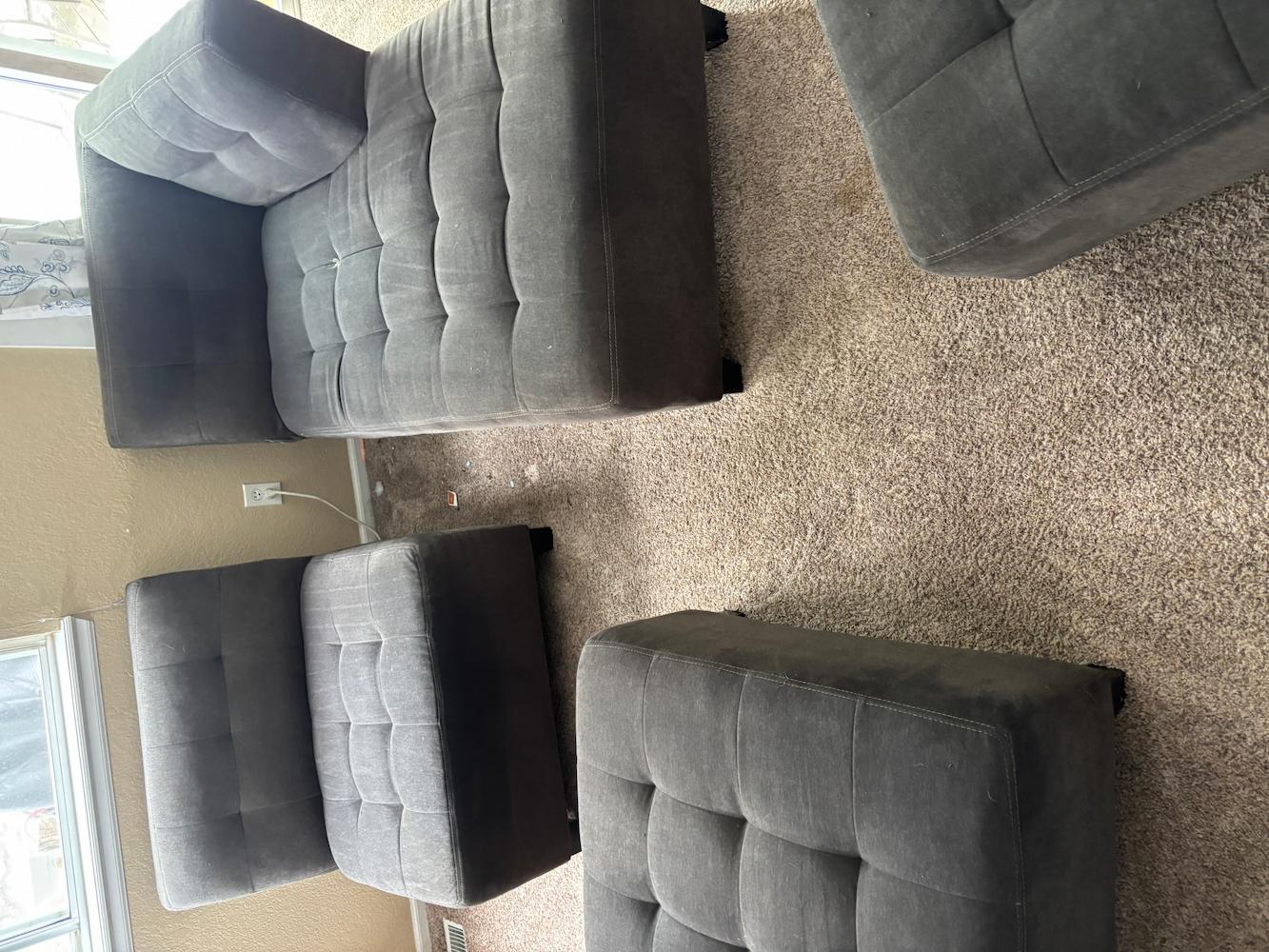
Pet urine is not a surface problem. When a dog urinates on carpet, the liquid moves fast — through the face fiber, through the backing, and into the padding below. With two large German Shepherds, the volume per incident is substantial. Over time the uric acid crystals bond to the fiber at a molecular level.
Uric acid does not dissolve in water. This is the reason standard cleaning fails. Hot water alone reactivates the crystals and can actually make the odor stronger before it gets better. The chemistry has to come first — a professional-concentration enzyme pre-treatment that breaks the uric acid bond before any extraction begins.
Upholstery adds a second layer of complexity. The foam core of a sectional behaves like a sponge. Urine saturates down through the fabric, through any batting layer, and into the foam itself. That foam holds moisture and uric acid for months. Without reaching it, no cleaning on the surface will hold.
The Red Line Protocol — What "Heavily Soiled" Actually Means
We use a tiered approach based on what the job actually needs. The red line designation means:
Enzyme pre-treatment applied at professional concentration and dwell time — not consumer spray-and-wipe
UV light inspection to map every contamination zone before we start
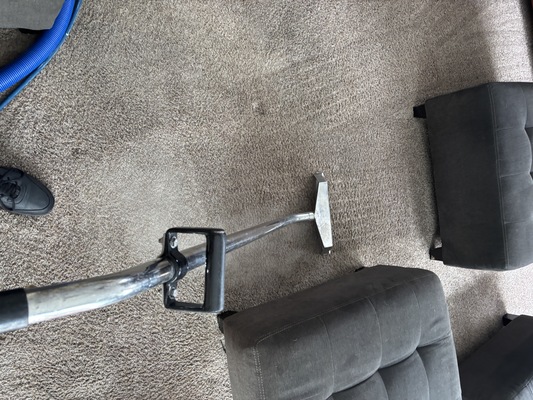
Sub-surface extraction tool on carpet to pull from the backing and padding simultaneously with the face fiber
Full upholstery treatment — hand-scrub first, then truckmount extraction
When the contamination is heavy, skipping any one of those steps shows up in the result within 30 days.
Hand-Scrubbing the Upholstery First — Why We Do It This Way
This is the part that takes the most time and the part our customers notice most.
Before we attach any truckmount tool to the upholstery, we pre-scrub the fabric by hand. This means working the enzyme chemistry into the fabric weave manually with a soft brush — section by section, panel by panel. On a large sectional that fills most of a living room, that is a lot of surface area.
Why do we do it this way? Because fabric code matters and mechanical agitation unlocks the chemistry.
Most synthetic upholstery falls under Fabric Code W — water-based cleaning safe. But even within that category, the enzyme pre-treatment has to reach the contamination zone, not just sit on the surface. Hand-scrubbing drives the chemistry into the fiber and loosens the uric acid crystal bond before the heat and pressure of the truckmount finish the job.
People notice this step. It communicates that the cleaning is not being rushed. It also produces a measurably better result because the extraction tool on a solo pass cannot replace what manual agitation does at the fiber level.
Truck mount Extraction — What the Machine Does That Nothing Else Can
After the hand-scrub and dwell period, we extract with the truckmount. Our Prochem Apex GTX runs at temperatures between 200 and 230 degrees Fahrenheit and produces suction that no portable unit can match.
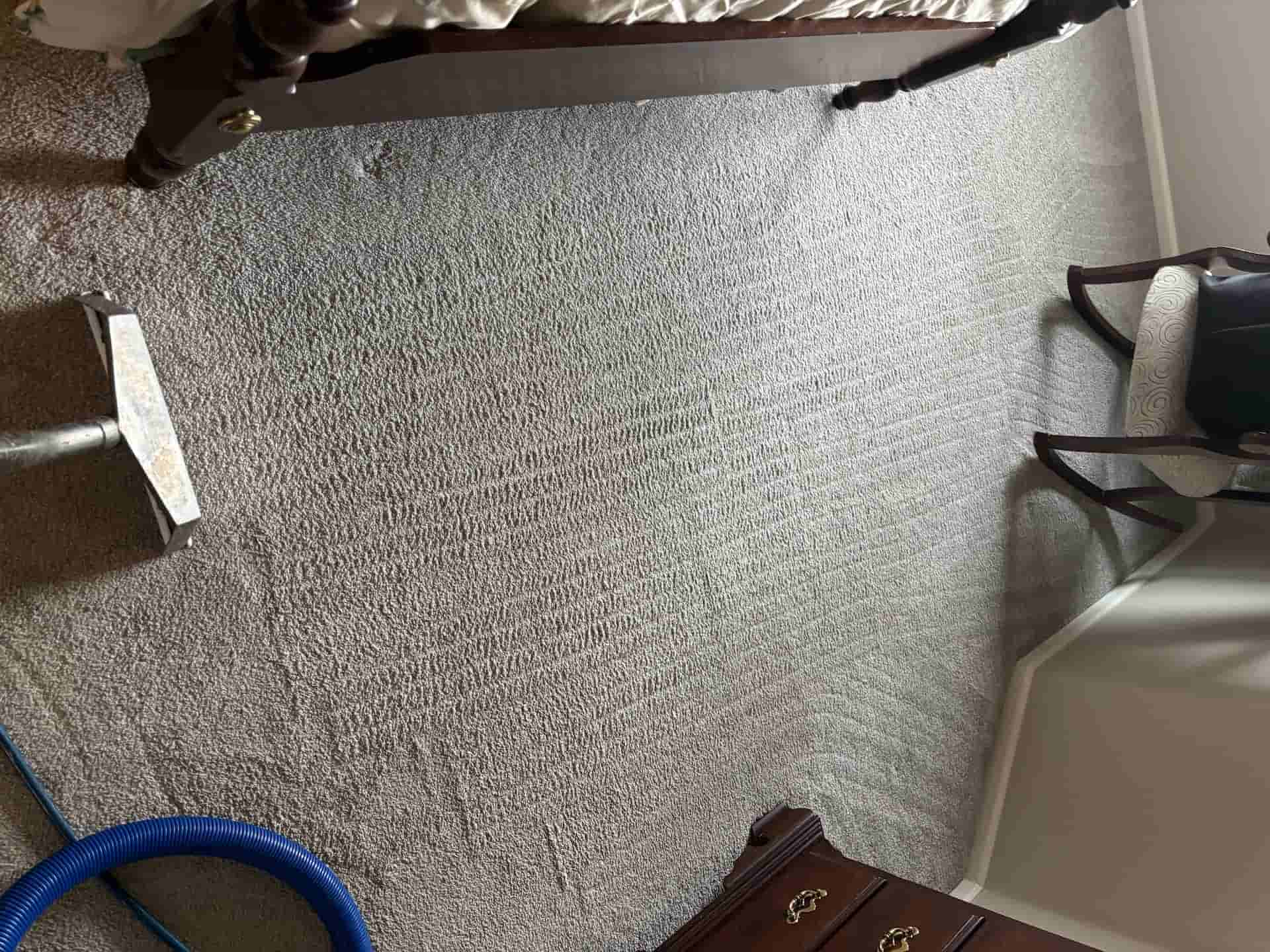
For upholstery, heat matters. At those temperatures, the enzyme chemistry activates fully and the extraction pulls contaminated moisture out of the foam core — not just the fabric surface. For carpet, the sub-surface extraction tool reaches the backing and padding simultaneously so the contamination does not stay trapped below the face fiber.
This two-pass method — hand-scrub then machine extract — takes roughly twice the time of a single-pass extraction. The result is not twice as clean. It is measurably, consistently better in a way that holds for months rather than weeks.
The Comparison — One Pass vs. Two Pass
Why Littleton Homes With Large Dogs Need This Level
Dakota Ridge and the surrounding Littleton neighborhoods see a high rate of pet households. Jefferson County foothills clay tracks in on paws and feet, and the Denver Basin aquifer water supply means elevated mineral content that competes with enzyme chemistry if the concentration is not calibrated correctly.
We adjust enzyme concentration on jobs with hard water because calcium and magnesium ions reduce the effectiveness of standard dilution. That calibration is part of what 23 years of Front Range cleaning experience produces — not something that shows up in a service checklist.
For pet urine and odor removal in Littleton, visit our pet stain and odor removal service page. For full Littleton carpet cleaning information including neighborhoods we serve, visit the Littleton hub. For upholstery cleaning information and fabric code guidance, see our upholstery service page.
Frequently Asked Questions
Why does pet odor come back after cleaning if the carpet looks clean?
Uric acid crystals bond to carpet fiber at a molecular level and are not removed by water or standard cleaning chemistry. If the enzyme pre-treatment does not reach the contamination zone at sufficient concentration and dwell time, the crystals remain intact and reactivate with humidity or heat. Surface appearance does not indicate whether the uric acid bond has been broken.
Can upholstery foam be cleaned without replacing it?
In most cases, yes — if the contamination has not reached a point of structural foam breakdown. Professional enzyme pre-treatment followed by high-temperature truckmount extraction can pull uric acid contamination from foam core on most residential sectionals and sofas. Jobs with years of unaddressed saturation may require cushion replacement in addition to fabric cleaning.
How long does a full pet urine carpet and upholstery treatment take?
A heavily soiled job combining carpet and a large upholstered sectional under the red line protocol typically runs three to four hours depending on square footage and contamination depth. Single-pass jobs on moderately soiled carpet run significantly less. If a quote sounds fast for the scope of the job, the protocol is likely abbreviated.
How We Know Dakota Ridge
Dakota Ridge sits in southwest Littleton near the foothills — established neighborhoods, larger lots, the kind of homes where big dogs have room to move. We have cleaned in this area for years. The combination of Jefferson County soil tracking in on paws, Denver Water mineral content, and the size of the homes makes pet contamination jobs here more complex than they look at the surface level. We bring the full protocol because the soil profile demands it.
Ready to book? Call (720) 730-8055 or submit online at coloradochoicecarpet.com
