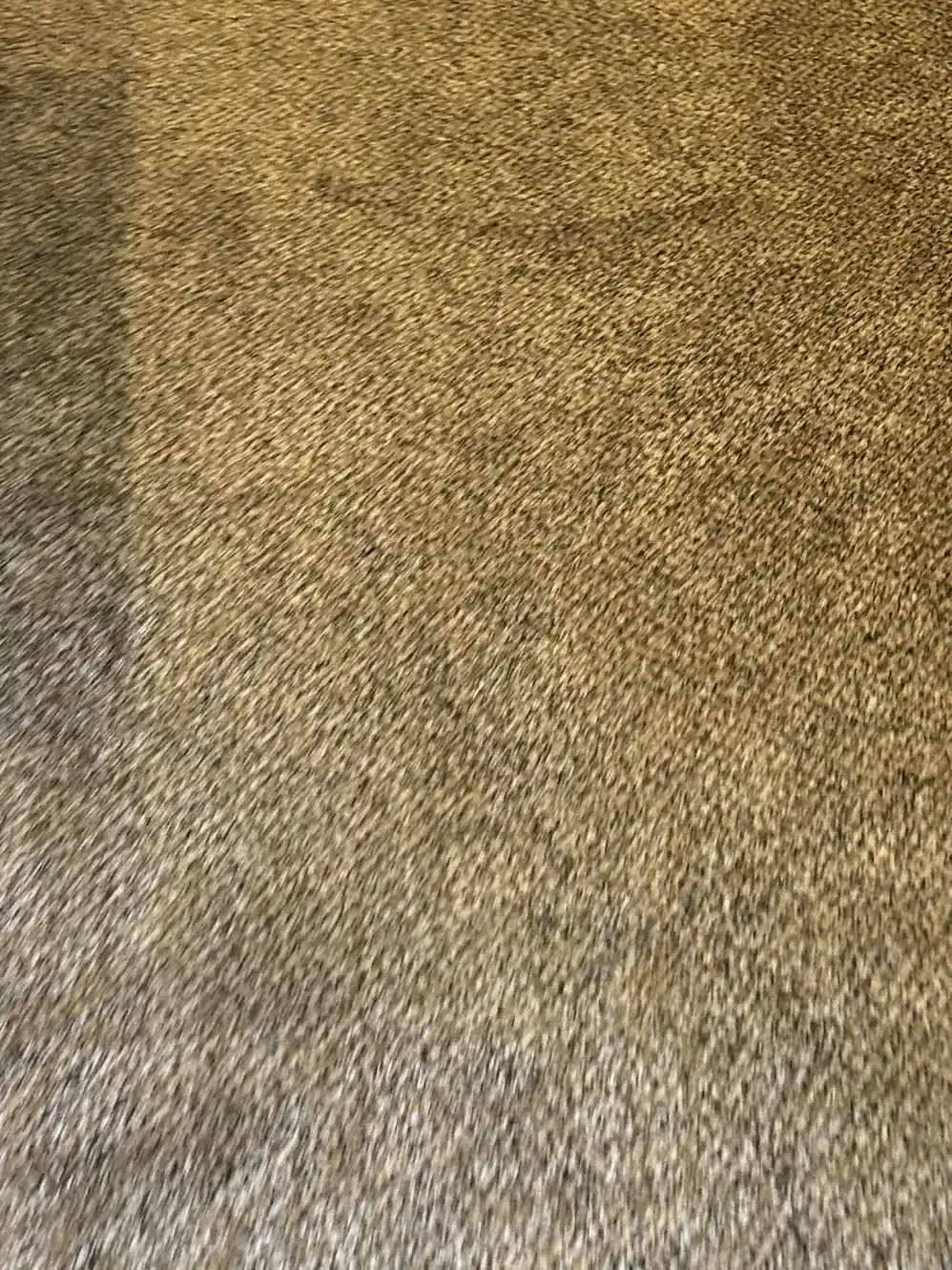
Littleton Carpet Cleaning — Heavy Traffic Lane Ken Caryl Wheelchair Job
Why Nylon Carpet Traffic Lanes Get So Dark in Littleton — And What It Takes to Bring Them Back
The bottom line up front: heavy carpet traffic lanes — especially in homes with high daily foot (and wheel) traffic — are caused by a combination of compressed fiber, bonded soil, and abraded pile that standard vacuuming cannot reverse. Professional hot water extraction with a high-alkalinity prespray and proper dwell time can recover 70–80% of appearance on builder-grade nylon. That's not a partial result. That's the realistic ceiling when fiber has been mechanically damaged over years of use.
Here's what happened on a recent afternoon in Ken Caryl, and why it matters if your carpet looks the same way.
What a Traffic Lane Actually Is (And Why It Gets So Dark)
A traffic lane is the darkened, compressed pathway that forms wherever people walk the same route repeatedly — entry to kitchen, hallway to bedroom, living room to bathroom. On builder-grade nylon carpet, which is the most common fiber type in Littleton residential construction, the pile is engineered for cost efficiency, not durability under heavy repetitive load.
Two things happen over time in those pathways:
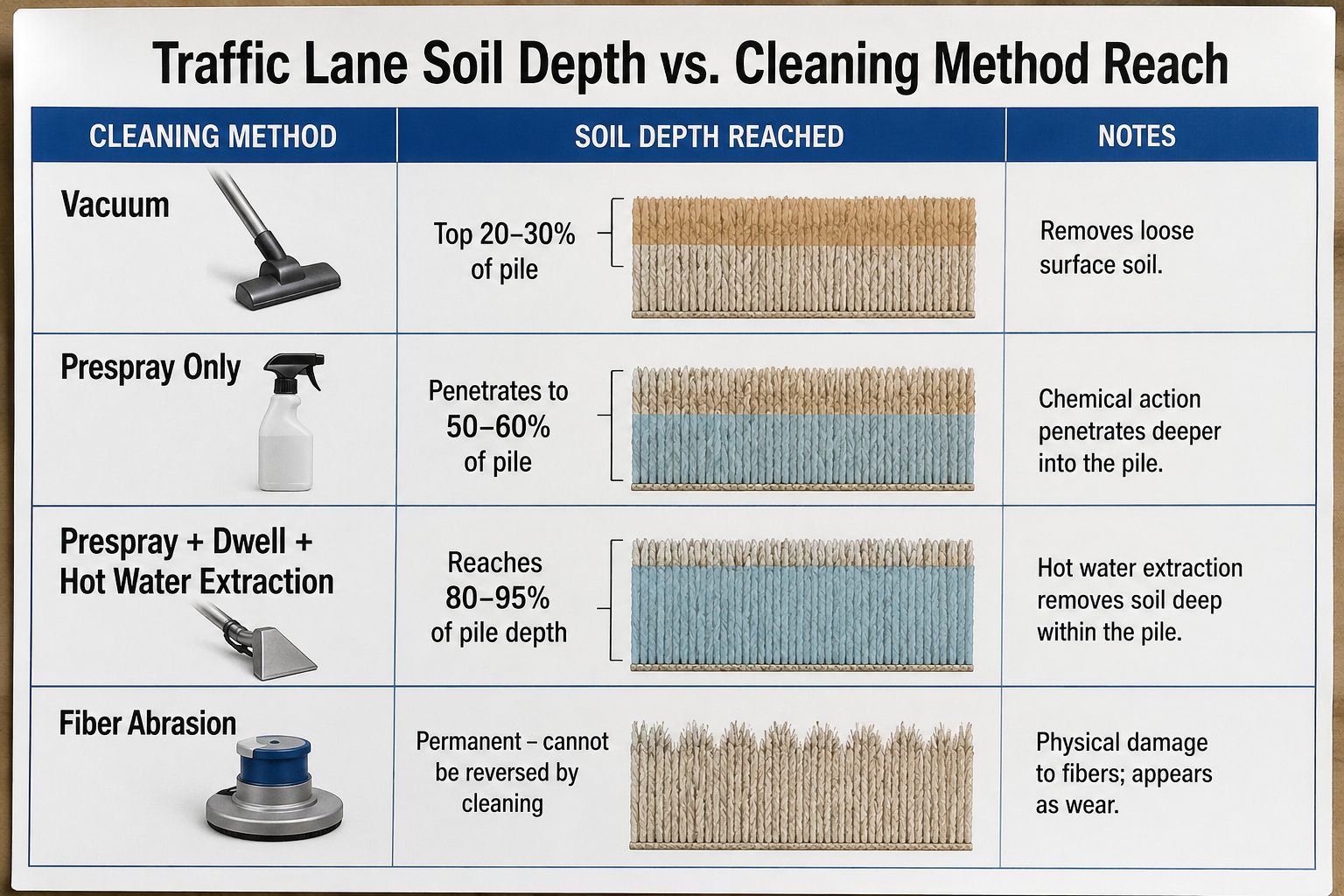
- SOIL BONDING: Dry soil, road treatment chemicals tracked in from outside, and body oils from bare feet work down into the fiber base. A vacuum cleaner only reaches the top 20–30% of the pile. The deeper the soil, the more it bonds to the fiber through repeated compression.
- FIBER ABRASION: The pile tips flatten and the fiber itself gets mechanically abraded — tiny scratches on the nylon strand that scatter light differently than undamaged fiber. This is what makes cleaned traffic lanes still look slightly darker than untouched carpet even after a thorough extraction. The carpet isn't dirty. The fiber is worn.
Pre-treatment chemistry is the only tool that addresses the bonded soil layer. The fiber abrasion is permanent — but reducing the soil load makes an enormous visual difference.
The Ken Caryl Job — A Retired Couple, a Wheelchair, and a Very Hot Afternoon
It was 94 degrees when we pulled up to this Ken Caryl home. The customers were a retired couple — one of whom uses a wheelchair daily. The wheelchair path was the job. Not the whole house. Just the traffic lanes created by years of the same routes traveled, day in and day out, through the main living area and into the bedroom.
Wheelchair traffic creates a different traffic lane profile than foot traffic. The contact patch is narrower, the pressure is more concentrated, and the path is extremely consistent — the same 18-inch strip gets compressed on every single pass. Over time, that produces a soil and fiber compression pattern more intense than you'd see in a standard high-traffic home.
[PHOTO 1: Traffic lane visible in main living area before cleaning — wide shot showing path from entry to kitchen]
The carpet was builder-grade nylon. Standard residential construction — the kind of carpet that goes into the majority of Littleton and Ken Caryl homes built in the 1980s through 2000s. Good fiber, but not engineered for this level of daily mechanical load.
The customer's main concern was straightforward: make those lanes look as good as we can. They understood the carpet had been through years of use. They weren't expecting new carpet. They wanted honest improvement.
The Process: Red Line Pre-Spray, a Grooming Rake, and a 20-Minute Dwell
On a job like this, the prespray selection and dwell time do most of the work. Hot water extraction is the extraction mechanism — but you have to loosen the soil before you can pull it out.
We mixed a fresh batch of Red Line Pre-Spray Powder Concentrate — a high-alkalinity powder prespray formulated specifically for heavy soil on commercial-grade and residential nylon carpet. Applied it directly down the traffic lane.
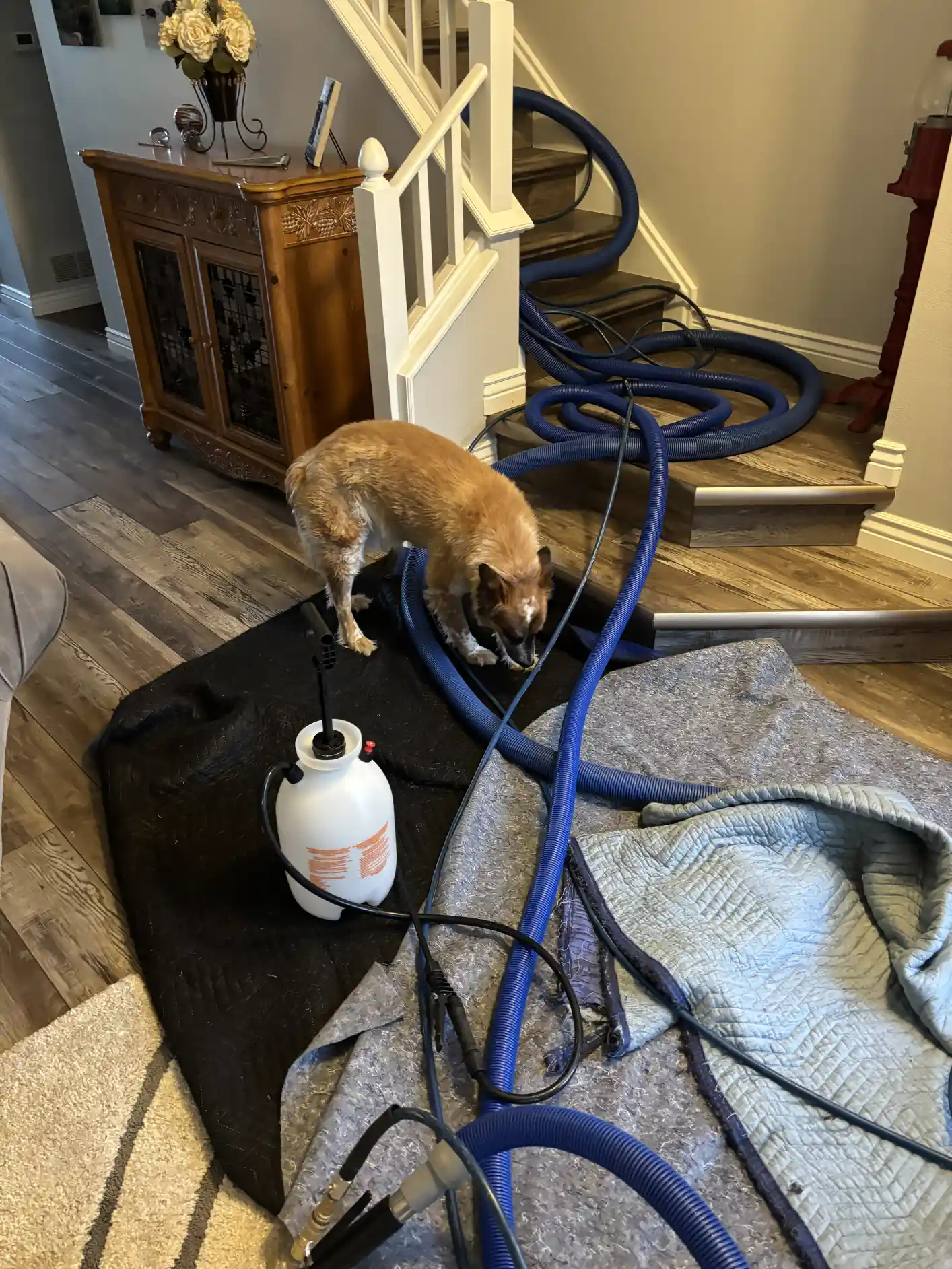
Then we took a grooming rake and worked the product into the pile — not just the surface, but pushing it down into the fiber structure where the bonded soil lives. This step matters more than most customers realize. A prespray sitting on top of the pile is working at maybe half its capacity. A prespray worked into the pile with a rake is in contact with the soil it needs to break down.
Dwell time: 20 minutes. On a 94-degree afternoon, chemistry works faster — heat accelerates the alkaline reaction — but we still let it sit the full dwell to make sure the product had time to penetrate and break the soil bond before we started extracting.
While the prespray was dwelling, we finished setting up the rest of the job and prepped the other areas. Then we ran the Prochem Apex GTX truckmount through the traffic lanes first, followed by the rest of the cleaned areas.
Hot water extraction at 200–230°F pulls suspended soil out of the fiber from the base up. The combination of alkaline prespray chemistry, mechanical grooming, proper dwell, and high-temperature extraction is the full protocol for a traffic lane this severe.
Why 70–80% Recovery Is a Win — Not a Failure
We brought the traffic lanes back to roughly 70–80% of their original appearance. The customers were happy — genuinely happy, not "well I guess that's okay" happy.
That number deserves context. The remaining 20–30% that we couldn't recover isn't dirty carpet. It's fiber abrasion — the mechanical wear on the nylon pile itself, caused by years of repeated compression and friction. No cleaning process can reverse that. It's a physical change to the fiber, not a soil condition.
What we did recover was everything that could be recovered: the bonded soil load, the surface oils, the road chemical residue, the compacted debris from the base of the pile. The carpet wasn't new when we left. But it was clean, and it looked dramatically better than when we arrived.
For a couple where one partner's daily mobility route runs directly through those carpet lanes, that improvement is real and lasting.
How We Know Littleton
Ken Caryl isn't just a neighborhood we service — it's one we've been in regularly for years, cleaning carpet in the kind of 1980s and 1990s construction that defines this part of Littleton. The builder-grade nylon, the foothills clay tracked in from the trails, the Denver Water mineral load that affects how chemistry performs — we calibrate for all of it.
Littleton carpet cleaning covers the full range of what we do in this area, from Ken Caryl to Columbine to Roxborough Park adjacency. If your traffic lanes look like what we described here, the protocol is the same.
Colorado Choice Carpet Cleaning — Castle Rock and Centennial | (720) 730-8055
Serving Ken Caryl, Columbine, Roxborough Park, and all of [LINK: Douglas County carpet cleaning].
Frequently Asked Questions
What causes carpet traffic lanes to get so dark in Littleton homes?
Traffic lanes darken from two separate causes: bonded soil and fiber abrasion. Bonded soil — from foot and wheel traffic, road treatment chemicals, and body oils — packs into the lower pile over time and cannot be removed by vacuuming. Fiber abrasion is mechanical wear on the nylon strand itself, which changes how light reflects off the pile. Professional hot water extraction with alkaline prespray removes the bonded soil. The fiber abrasion is permanent, which is why traffic lanes often still appear slightly different from untouched carpet even after a thorough cleaning.
How long should a traffic lane prespray dwell before extraction?
Dwell time depends on soil load, product concentration, and ambient temperature. For heavy traffic lanes with builder-grade nylon, 15–20 minutes is standard. On hot days, chemistry activates faster — but a full dwell ensures the alkaline product penetrates to the base of the pile where bonded soil lives, rather than just working on the surface. Cutting dwell time short is one of the most common reasons traffic lane results fall short of expectations.
Can wheelchair traffic lanes be cleaned the same way as regular foot traffic lanes?
The protocol is the same — alkaline prespray, grooming rake, dwell, hot water extraction — but wheelchair traffic lanes typically require more attention to prespray volume and dwell time. The contact patch is narrower and the pressure is more concentrated than foot traffic, which produces denser soil bonding and more fiber compression in a tighter strip. The recovery ceiling is also lower on wheelchair paths because the mechanical abrasion to the fiber is more intense. Realistic expectations are important: 70–80% appearance recovery on heavily used wheelchair routes is a strong result.
Call Colorado Choice Carpet Cleaning: (720) 730-8055
