Hot Water Extraction vs Low Moisture Cleaning — Denver
What Low Moisture Cleaning Left Behind in Denver's Clayton Neighborhood — And What Hot Water Extraction Fixed
The previous carpet cleaning company left pet stains in the carpet and walked out the door. We brought a truckmount running at 220 degrees and pulled out what seven years and a low moisture machine had buried in a nylon-polyester blend. The homeowner watched the waste line and couldn't believe what came out.
The Job — Clayton Post-War Home, Two Roommates, One Disappointed Homeowner
Clayton is one of Denver's oldest working neighborhoods. The homes here were built primarily in the 1940s and 1950s — part of the post-World War II housing expansion that turned this part of Denver into block after block of modest, well-built residential stock. This particular home had an addition on the back, where two roommates had been living.
Before the roommates moved out, they hired a low moisture cleaning company. The result was marginal. Pet stains were still visible. Soil hadn't moved. The carpet looked about the same as it had before the company arrived.
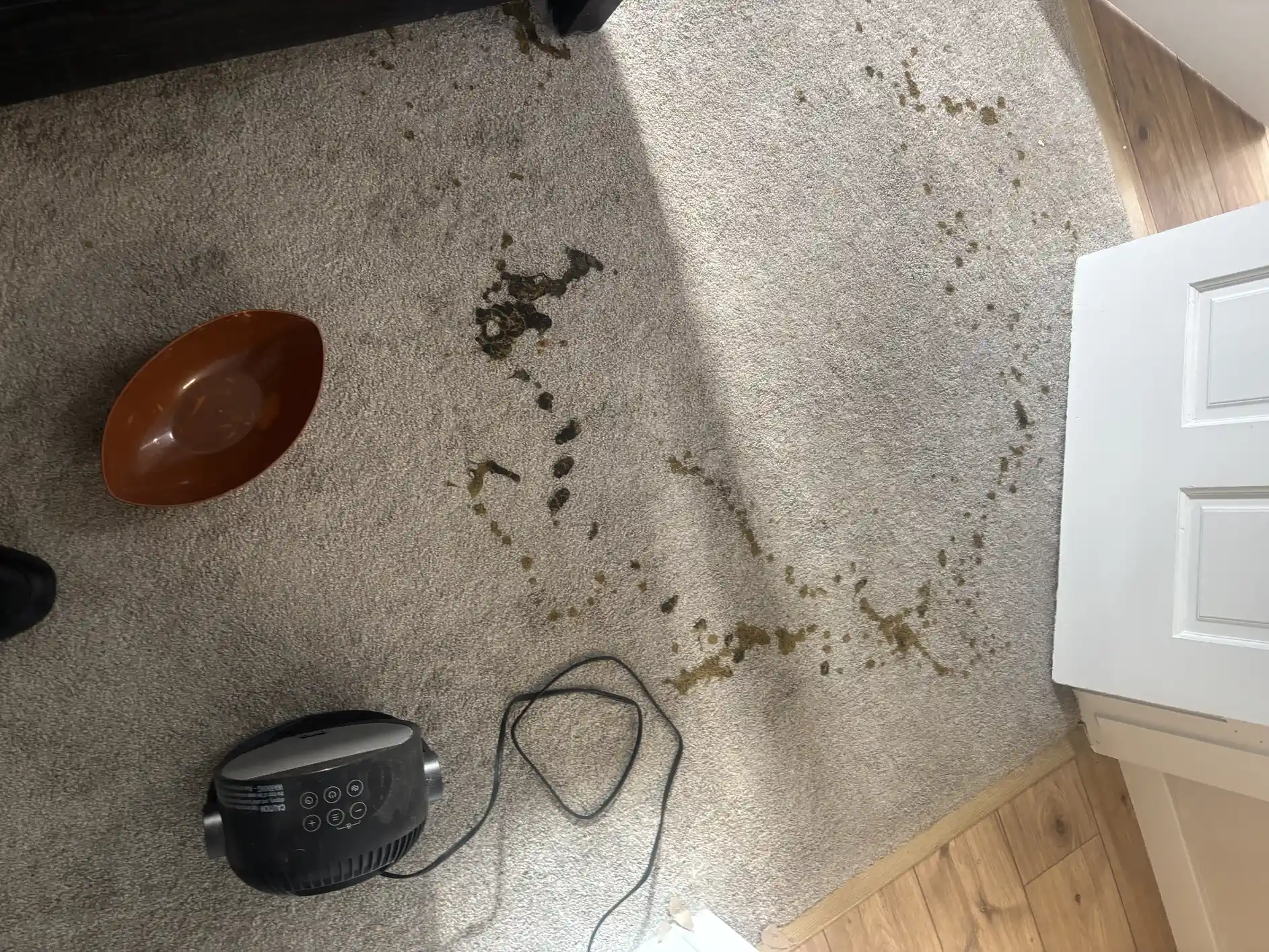
The homeowner had been in the house for seven years. The carpet was there when they moved in — a nylon-polyester blend that had absorbed seven years of daily foot traffic, pet activity, and the mineral-carrying Denver Basin water that runs through every tap in the city. When the low moisture company's results didn't hold, they called us.
What Low Moisture Cleaning Can and Cannot Do
Low moisture cleaning has a place in the industry. For lightly soiled commercial carpet on a maintenance schedule, where dry time is the primary concern and soil load is managed, it can be a reasonable method. That is not what this job was.
Soil Removal Effectiveness — Low Moisture vs Hot Water Extraction
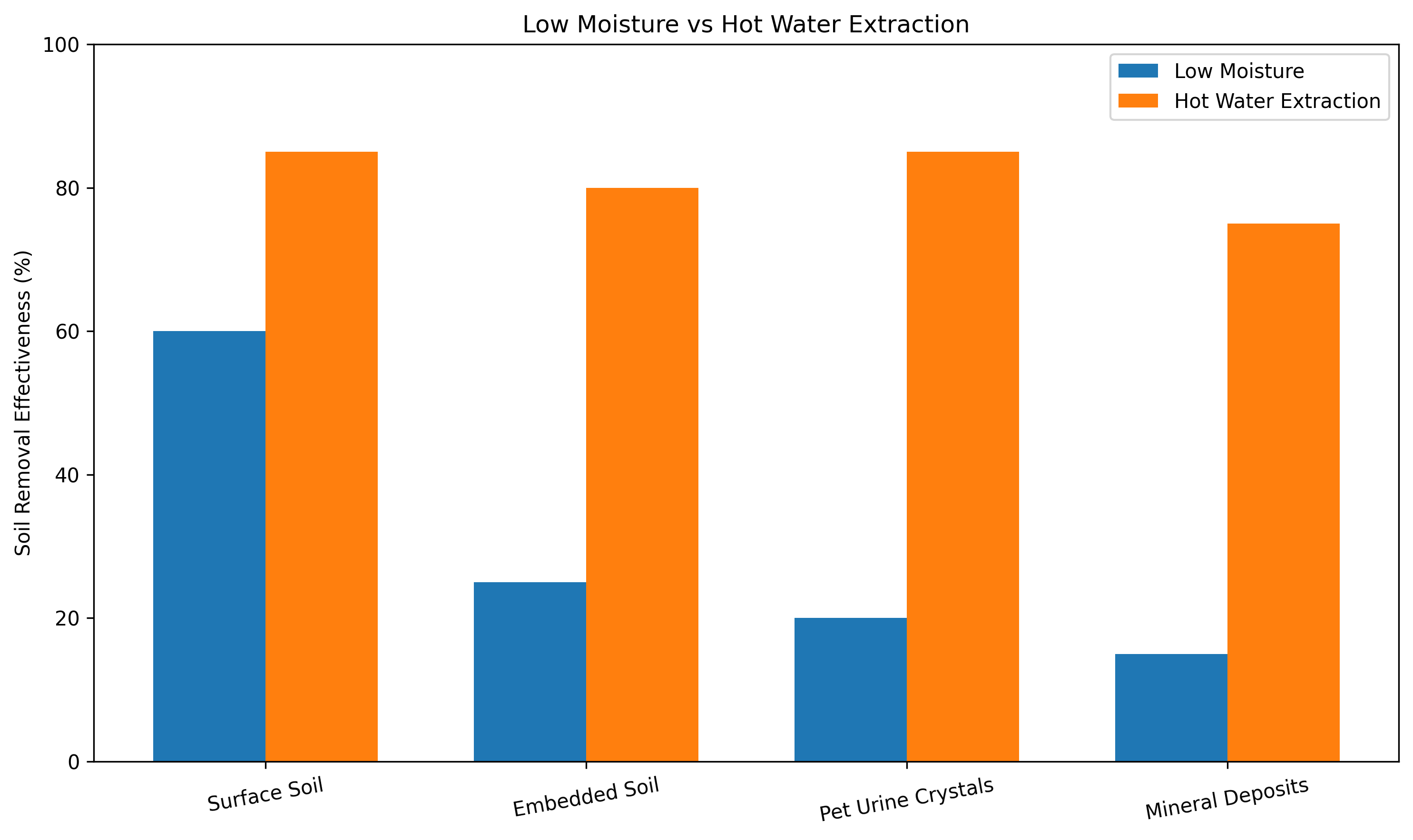
The issue with pet stains specifically is chemistry. Uric acid crystallizes in the fiber and the backing as moisture evaporates. Those crystals do not respond to surfactant alone. They require heat to break the molecular bond — and a low moisture machine operating at ambient temperature simply cannot generate the heat needed to dissolve what has been setting in that carpet for years.
What the Prochem Apex GTX Did Differently
We pre-treated the pet stain zones with Saiger's P-Lime-Zyme and let it dwell for 30 minutes. P-Lime-Zyme is an enzyme-based urine treatment formulated at professional concentration — not the diluted consumer versions available at retail. The enzyme works on the uric acid molecule directly, breaking it down at the source before our hot water extraction carpet cleaning process begins.
It was 90 degrees outside that day. The incoming water temperature was already elevated — warm tap water entering the Prochem Apex GTX system means the truckmount reaches working temperature faster and holds it more consistently. We ran the extraction at 220 degrees Fahrenheit.
The Prochem Apex GTX is a truck-mounted extraction system. The heat and pressure it generates are not comparable to a portable unit or a low moisture machine — they operate in a different class entirely. When the wand made the first extraction pass over the pre-treated pet stain zones, the waste line showed exactly what had been sitting in that carpet.
The homeowner was watching. The reaction was immediate. Every pass pulled material that the previous cleaning had left behind — dissolved uric acid crystals, years of embedded mineral-carrying soil, and the kind of particulate that works its way below the surface fiber and stays there unless heat and pressure reach it.
The Science — Why Temperature and Pressure Win on Pet Stains and Embedded Soil
Nylon-polyester blend carpet holds soil differently than a single-fiber construction. Nylon is durable and resilient — it accepts dye well and holds its structure under traffic. Polyester is hydrophobic, which means it resists water absorption but also resists water-based cleaning if chemistry and temperature are not sufficient to overcome that resistance.
Uric acid crystals, once set in carpet fiber, behave like a mineral deposit. Heat above 180°F begins to dissolve the crystalline structure. At 220°F with IICRC S100 extraction pressure behind it, the enzyme pre-treatment for pet urine has done its work — the broken-down uric acid has nowhere to go except up the waste line.
Denver Basin water — the municipal water supply across Denver — carries calcium carbonate and magnesium in solution. Over seven years in a carpet, those minerals deposit in the fiber alongside soil. Low moisture cleaning does not generate the pressure or the rinse volume needed to pull mineral-bonded soil out of the fiber matrix. Hot water extraction does.
At 5,280 feet, Denver's lower atmospheric pressure actually assists extraction — the reduced ambient pressure differential increases the effective vacuum pull at the wand face. The carpet also dries faster at elevation due to lower humidity and higher evaporation rate, which is the one area where low moisture cleaning's primary selling point — faster dry time — is largely neutralized in Colorado.
FAQ — Hot Water Extraction vs Low Moisture in Denver
Does low moisture cleaning work on pet stains?
Low moisture cleaning is not designed for active pet stain remediation. Uric acid crystals require heat above 180°F to dissolve, and enzyme pre-treatment at professional concentration to break down at the molecular level. Low moisture machines operate at ambient to slightly elevated temperatures and do not generate the extraction pressure needed to pull dissolved crystals and mineral-bonded soil out of carpet fiber. For light maintenance cleaning on low-soil commercial carpet, low moisture has a place. For pet stains in residential carpet — especially in older Denver housing stock where soil has accumulated over years — hot water extraction is the appropriate method under the IICRC S100 standard.
Why does hot water extraction remove more soil than low moisture methods?
Hot water extraction operates at 200-230°F with extraction pressure between 500-1,200 PSI depending on fiber type and soil load. That combination of heat, chemistry dwell time, and pressure reaches through the surface fiber into the mid-pile and backing where embedded soil, uric acid crystals, and mineral deposits from hard Denver Basin water accumulate. Low moisture methods clean the upper fiber layer effectively but do not penetrate to where years of compacted soil actually lives. The IICRC S100 standard identifies hot water extraction as the primary recommended cleaning method for residential carpet for this reason.
How does Denver's climate affect carpet cleaning method choice?
Denver's lower atmospheric pressure at 5,280 feet increases the effective vacuum pull during hot water extraction, improving soil removal efficiency. Lower ambient humidity accelerates dry time — the primary advantage claimed by low moisture cleaning — which means that advantage largely disappears at Denver's elevation. Denver Basin hard water also deposits calcium carbonate and magnesium in carpet fiber over time, requiring the rinse volume and pressure that only truckmount extraction provides to fully remove. The combination of elevation, low humidity, and hard water mineral accumulation makes hot water extraction the better-calibrated method for Denver residential carpet cleaning.
How We Know Denver
Denver spans more than 150 years of residential and commercial construction — from 1890s Victorian stock in Curtis Park and Potter-Highlands to post-war bungalows in Clayton and Montbello to 2000s and 2010s construction in RiNo and the River North corridor. Each decade of housing brings different carpet types, different subfloor conditions, and different soil accumulation patterns.
Clayton in particular represents the post-WWII boom — homes built fast, built to last, and now carrying 70 to 80 years of occupancy history in their subflooring, padding, and carpet fiber. We calibrate chemistry and temperature to what the carpet has absorbed, not just what is visible on the surface.
We serve our full Denver carpet cleaning service area across all carpet cleaning, pet stain and odor removal, tile, upholstery, and hard floor services. Call (720) 730-8055.
Ready to See What Your Carpet Is Actually Hiding?
If a previous cleaning company left stains behind, the problem is usually method — not the carpet. Hot water extraction at 220°F with professional enzyme pre-treatment removes what low moisture cleaning cannot reach. We serve Clayton and all Denver neighborhoods.
Call Colorado Choice Carpet Cleaning: (720) 730-8055 or book online.
