Coffee Stain Wool Carpet — Downtown Denver Hotel | Colorado Choice
Coffee Stain on Wool Carpet in a Downtown Denver Hotel — 8PM, Tight Window, Five-Year Account
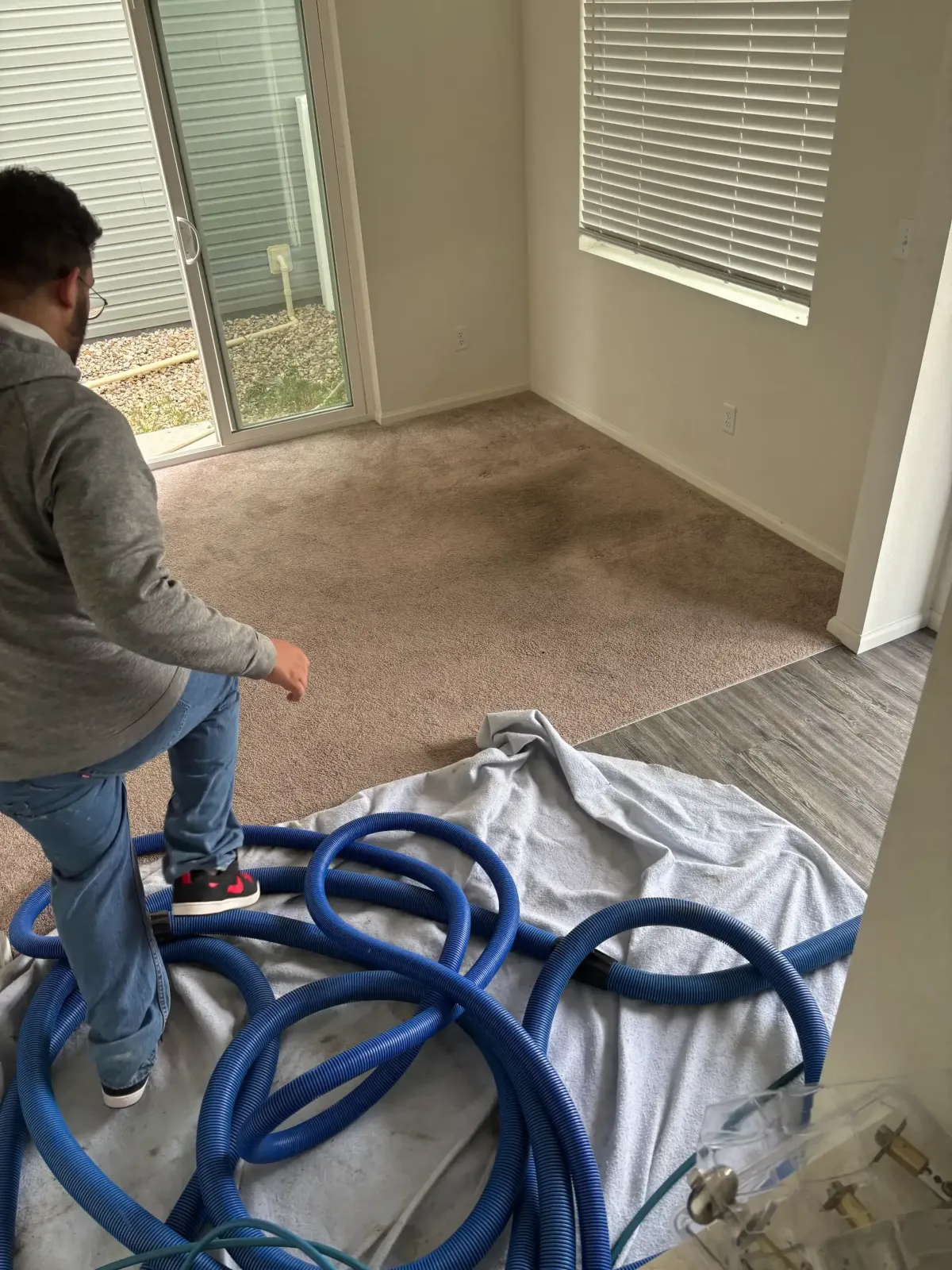
At 8 o'clock on a Friday night at the end of the month, we were cleaning a dried coffee stain out of Berber-style wool carpet in a downtown Denver hotel and short-term rental property. The handyman had already attempted the stain. Checkout was at 11AM. New guests arriving the next afternoon. We have held this account for five years — 100 units, two to three visits per month — and we have never been late. This is what wool carpet coffee stain removal looks like under a commercial time constraint, and why the chemistry has to be right the first time.
The Property — Wall-to-Wall Wool in Every Unit of a Downtown Denver Short-Term Rental
This property sits in the heart of downtown Denver — a high-end hotel and Airbnb hybrid that is rare in one specific way: every unit is carpeted wall to wall in Berber-style wool. In a city where most new construction goes straight to LVT or hardwood, this building made a deliberate premium choice. Wool carpet in a short-term rental at this price point signals luxury. It also signals a cleaning challenge that most commercial carpet cleaning in Denver companies will not take on.
Most carpet cleaning companies avoid wool. The fiber is pH-sensitive, moisture-sensitive, and unforgiving if the wrong chemistry is applied. Alkaline cleaners above pH 8 will damage the cuticle structure of the wool fiber permanently. Steam at high temperature will felt the pile. Overwetting causes shrinkage at the seams. For a 100-unit building where every floor is wool, you need a cleaner who understands the fiber — not one who is figuring it out as they go.
We have been the exclusive carpet cleaning provider for this property for five years. Two to three visits per month, every month, across all 100 units. The property manager knows us by name. When something goes wrong between scheduled visits — a guest spills something, a stain shows up at checkout — we get the call.
The Call — End of Month, 8PM, Handyman Already Tried
The end of the month is always the busiest period for a carpet cleaning company serving the Denver Metro area. Move-outs, move-ins, tenant turnovers — every building hits at once. We were already running a full day when the call came in from the property manager.
A unit had a dried coffee stain on the Berber wool. Checkout had already happened. New guests were arriving the next afternoon. The handyman had been in first — property managers almost always send their handyman before they call us, and the handyman almost always makes it harder. Consumer spotting products on wool can set a tannin stain deeper into the fiber, alter the pH of the affected zone, and leave surfactant residue that attracts soil faster than the original stain.
By the time we arrive on a handyman-treated wool stain, we are not just removing coffee. We are removing coffee plus whatever was applied first.
We said yes. We were there at 8PM.
Why Coffee Stains on Wool Berber Are Harder Than They Look
Coffee is a tannin-based stain. Fresh tannin on wool fiber is relatively straightforward — low pH chemistry, dwell time, careful extraction. Dried tannin that has been sitting for hours or days is a different problem. The tannin bonds more deeply to the wool protein fiber as it dries. Heat from a handyman's hot water attempt or a steam-based consumer product accelerates that bond further.
Berber construction adds another layer of complexity. The loop pile structure means the fiber loops sit close together with minimal space between them. Staining fluid wicks down into the base of the loop and into the backing before it is visible at the surface. What looks like a surface stain on Berber wool is often a stain that has penetrated to the secondary backing.
The IICRC S100 Standard for wool carpet cleaning specifies:
pH range must stay between 5.0 and 8.0 — alkaline chemistry above pH 8 degrades wool protein permanently
Low moisture application — wool absorbs water and swells, increasing shrinkage risk at seams
No high-heat extraction directly on wool — heat accelerates dye migration and fiber damage
Tannin stains respond to low pH chemistry, not enzyme pre-treatment — enzyme chemistry targets protein and uric acid, not tannin
Consumer products and general-purpose carpet spotters frequently violate two or three of these conditions simultaneously. That is why the handyman's attempt makes our job harder, not easier.
The Process — Low pH Chemistry, Controlled Moisture, Careful Extraction
Our process on this job followed IICRC wool fiber protocol from first contact to dry pass. For stain and odor removal on natural fiber, the sequence is non-negotiable:
Pre-inspection: Assessed the stain zone, identified the handyman treatment residue, checked fiber pH with a test strip to establish baseline before applying any chemistry.
Chemistry selection:Low pH wool-safe spotting chemistry — pH calibrated to the 5.0–8.0 window required for wool protein fiber. Tannin stains respond to acidity, not alkalinity. The low pH chemistry breaks the tannin bond without disrupting the wool cuticle structure.
Application: Low-moisture application directly to the stain zone. No flooding the area — wool swells when oversaturated and Berber loop construction traps moisture at the base of the pile where it cannot evaporate freely. Controlled application with dwell time to allow the chemistry to work through the dried tannin.
Agitation: Gentle agitation with a soft brush — never a rotary tool on Berber loop pile. Rotary agitation on loop pile causes fuzzing and permanent pile distortion. Hand agitation working with the loop direction, not against it.
Extraction: Truckmount hot water extraction with temperature moderated for wool — lower than standard carpet setting. Sufficient heat to activate the chemistry and flush the fiber, not enough to cause fiber damage or dye migration. Multiple dry passes to pull maximum moisture out of the backing before leaving.
Result:Coffee stain fully removed. No residual tannin shadow. Fiber texture intact. Pile lying correctly. Dry enough for turnover by morning.
The Scheduling Reality — Why This Account Stays With Us
A downtown Denver hotel and short-term rental property operates on a schedule that does not flex. Guests check out at 11AM. The cleaning crew turns the unit. New guests arrive at 4PM the next day. There is no buffer.
When a carpet issue shows up at checkout — a stain the departing guests left, something the handyman flagged — the window to fix it is measured in hours, not days. A carpet cleaner who cannot commit to same-day carpet cleaning, who needs to schedule two days out, or who shows up late is not a viable partner for a property at this level.
In five years and hundreds of service calls across this building, we have not missed a window. We have been there at 8AM before a 10AM checkout inspection. We have been there at 8PM after a full day of residential jobs across the Denver Metro. End of month — the busiest period for move-out cleanings across Douglas and Arapahoe counties — we were still in this building on a Friday night because we said we would be.
That reliability is not incidental. It is the reason the account exists and the reason it has stayed with us for five years.
What Wall-to-Wall Wool Carpet in a Commercial Setting Actually Requires
Wool carpet in a hotel or short-term rental environment faces soiling patterns that residential wool does not. High foot traffic from rotating guests. Food and beverage spills — coffee, wine, room service. No consistent vacuuming protocol between stays. Soiling that accumulates faster than in an owner-occupied residence.
The maintenance protocol for commercial cleaning contracts at this property runs on a rolling schedule — two to three visits per month to cycle through units based on occupancy and condition. Spot calls like this one come in addition to the scheduled rotation.
What keeps commercial wool carpet performing in a property like this:
Consistent pH-neutral wool-safe chemistry only — no alkaline cleaning products, ever
Low-moisture extraction to prevent backing saturation and seam shrinkage
Immediate response to spills before guest or handyman attempts set the stain
Scheduled rotation cleaning to prevent soil buildup that becomes unrestorable
The units in this building that have been on the rotation for five years still look like the day they were installed. The ones that went longer between cleanings or had handyman interventions with the wrong chemistry show fiber damage that cannot be reversed.
FAQ — Wool Carpet Cleaning in Denver Commercial Properties
Can coffee stains be fully removed from wool carpet?
Yes — if the right chemistry is applied before the tannin bond sets permanently. Fresh coffee on wool responds quickly to low pH spotting chemistry applied with controlled moisture and careful extraction. Dried coffee that has been sitting for hours or treated with an alkaline consumer product is harder but still restorable in most cases if the fiber has not been damaged by heat or high-pH chemistry. The IICRC S100 Standard specifies pH 5.0–8.0 for wool fiber — staying within that range is the difference between full removal and permanent staining.
Why do most carpet cleaners avoid wool carpet?
Wool fiber requires chemistry, temperature, and moisture control that falls outside the standard hot water extraction protocol used on synthetic carpet. Alkaline pre-sprays, high extraction temperatures, and rotary agitation tools — all common in standard carpet cleaning — can permanently damage wool cuticle structure, cause dye migration, and felt the pile. IICRC-certified cleaners trained on wool fiber protocol understand the restrictions. General carpet cleaners working outside their training often cause more damage than the original stain.
How often should commercial wool carpet be professionally cleaned?
The IICRC recommends professional cleaning frequency based on foot traffic and soil load. For a high-turnover short-term rental environment with rotating guests, two to three professional cleanings per month per unit on a rotating schedule is consistent with maintaining wool carpet appearance and fiber integrity over the long term. Allowing soil to accumulate between cleanings increases the abrasive damage to the wool cuticle with each guest stay.
Serving Downtown Denver Commercial Properties
We were in a downtown Denver hotel at 8 o'clock on a Friday night at the end of the month because that is when the job needed to be done. Five years. Hundreds of service calls. Wall-to-wall Berber wool across 100 units. Every time we said we would be there, we were there — and every time we left, the carpet was clean.
If you manage a commercial property in Denver or the surrounding Metro area with wool carpet, specialty fiber, or a tight turnover schedule, call us. We know wool, we know commercial scheduling, and we do not miss windows.
Colorado Choice Carpet Cleaning
Parker Emergency & Same-Day Carpet Cleaning — IICRC-Certified
23+ Years. Owner-Operated. We Answer When You Call.
(720) 730-8055 | coloradochoicecarpet.com
Schedule Your Carpet Cleaning Today

