Castle Rock Carpet Cleaning – Plum Creek Pet Loss Backup Truck
A 14-Year-Old Black Lab, a Graduation Deadline, and the Day Our Truck Didn't Start
Some Jobs Are About More Than Carpet
It was 85 degrees and blue skies in Castle Rock today — the kind of late spring day that reminds you why people choose to live here. Two miles from our office, just off Plum Creek, sits an older neighborhood that predates most of what Castle Rock has become. The house was built in 1982. The customer has lived there 15 years. The carpet is seven years old and had never been professionally cleaned.
He called us because his dog died two weeks ago.
A 14-year-old black lab. He showed me pictures on his phone before I even started setting up. The dog had accidents toward the end — that's common with older dogs, and it's one of the harder things about loving an animal through its final months. The two dogs still in the house had started having sympathy accidents of their own. The carpet had taken on everything.
He had a graduation coming up. Family was going to be in the house. He had taken the day off work specifically for this. It needed to get done today.
Why the Pre-Treatment Dwell Time Matters More Than the Cleaning
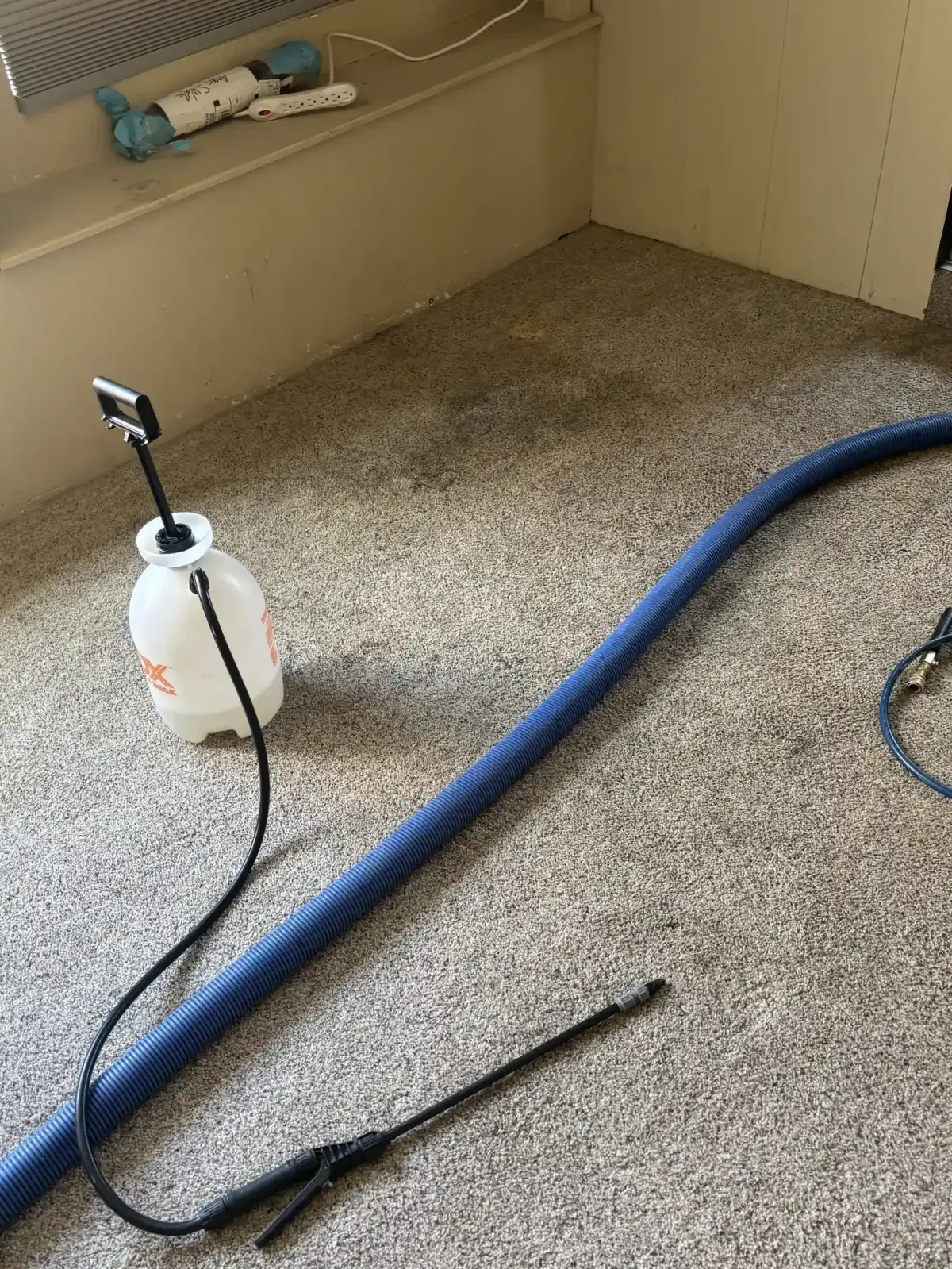
Before I touched the machine, I applied our enzyme pet pre-treatment to every affected area and set a timer for 45 minutes.
This is the step most people don't know about and most rushed cleaners skip. Enzyme pre-treatment works by breaking down uric acid crystals at the molecular level — the compounds in pet urine that cause odor and that bond to carpet fiber over time. The chemistry needs time to penetrate through the carpet face fiber, into the backing, and reach the padding below where the urine has migrated. Forty-five minutes is not arbitrary. It is the minimum dwell time for the enzyme to complete the first stage of that process on a job with this level of contamination.
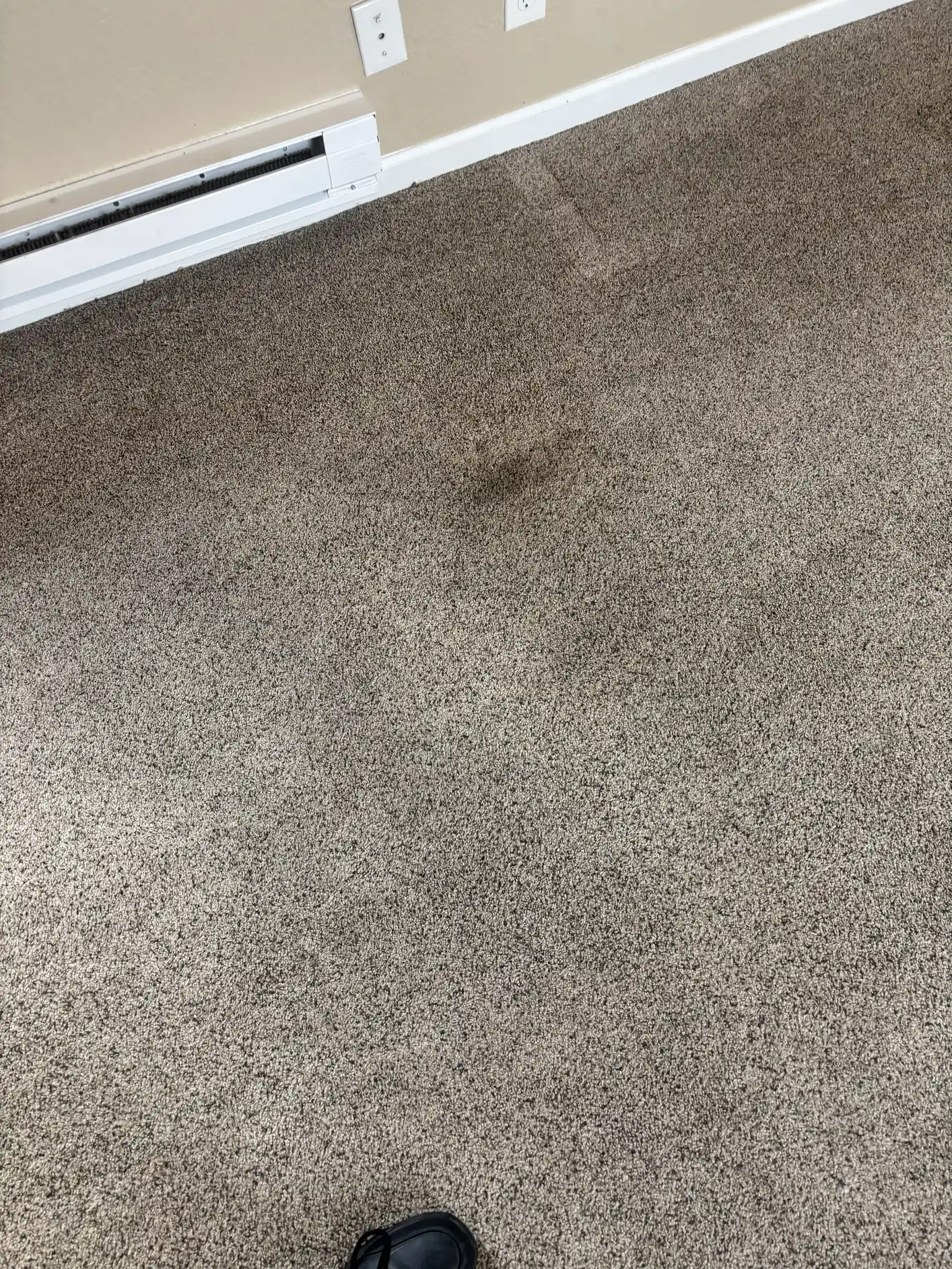
While the pre-treatment was working, I did what I always do on a job like this — I took time with the customer. Talked about the dog. Looked at the pictures. He had 14 years of stories. That time matters. Not just because it's the right thing to do, but because by the time we finished talking, the pre-treatment had done its job. When I went back to check the affected areas before starting the machine, the stains were already visibly lifting. The enzyme had worked. That's what 45 minutes looks like.
Then the Truck Didn't Start
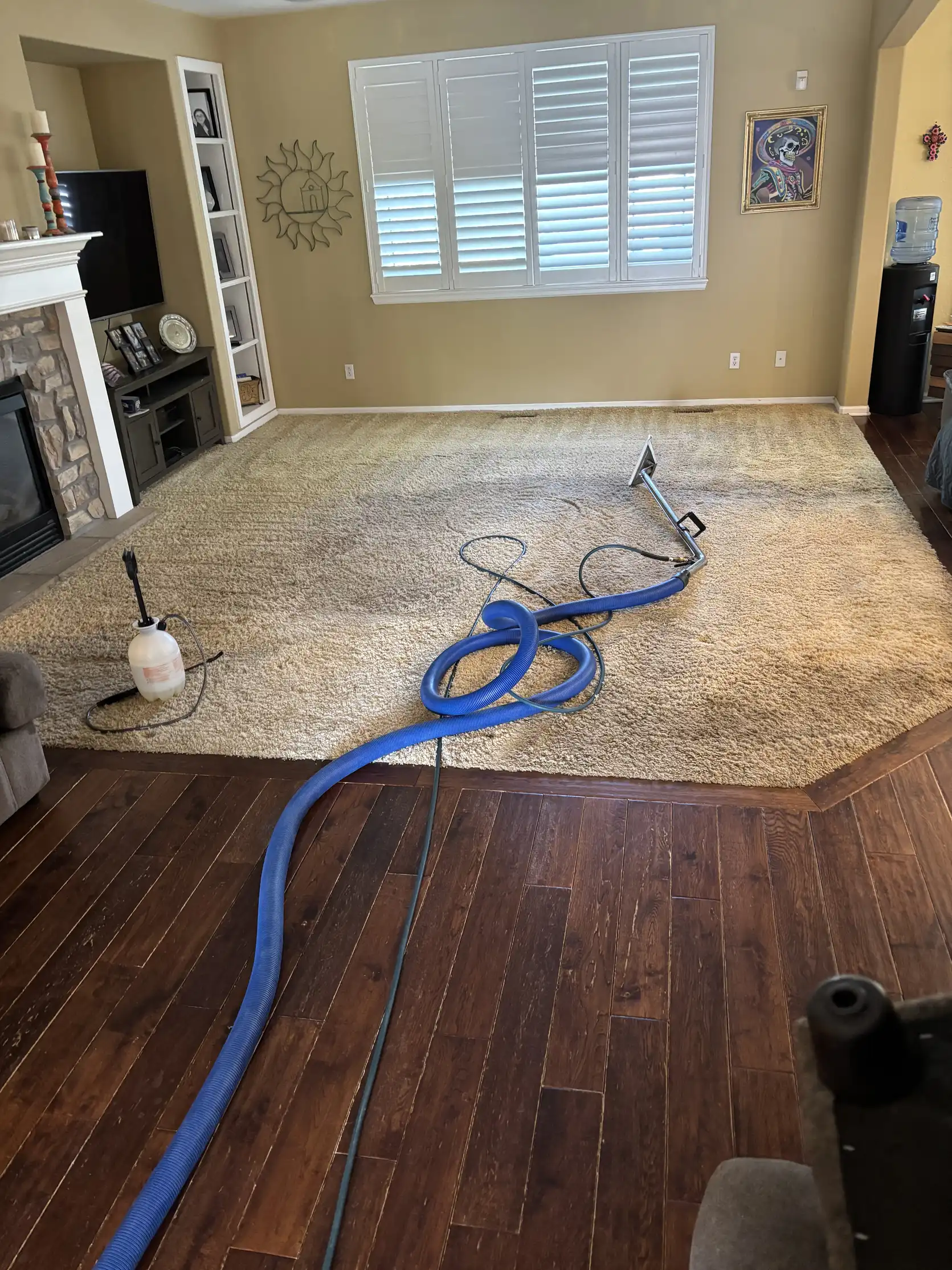
I walked out to the Prochem Apex GTX, turned the key, and nothing happened.
This is the part of the job nobody talks about in the marketing material. We work with mechanical equipment. Truckmount systems are sophisticated machines — high-temperature boilers, vacuum systems, chemical metering, water recovery. They run thousands of hours. And occasionally, without warning, they don't start.
There is nothing you can do in that moment except make a decision.
The customer had taken the day off. He had a graduation in days. His house smelled like pet urine and grief, and he had trusted us to fix it. Walking away or rescheduling was not an option I was going to offer him.
Why a Second Truck Is Not a Luxury — It's the Job
We have a backup truck. That is not an accident. After 23 years in this business, I will tell any carpet cleaner starting out the same thing I have learned the hard way: do not start this business with one truck if you can possibly avoid it. Mechanical things happen. Not if — when. And when they do, you are either the company that takes care of the customer or you are the company that calls and cancels on the day they took off work.
I went back to our Castle Rock location, switched to the backup truck, and was back at the customer's door in 35 minutes.
The job got done. Full hot water extraction on seven-year-old dark polyester carpet with significant pet contamination across multiple rooms. The enzyme pre-treatment had already done the heavy lifting — the extraction pulled everything out cleanly. The after pictures showed carpet that looked like it had been replaced.
What Happened When We Finished
Before I had packed up the hose, he told me he was going to write the greatest review we had ever received.
He did. Right there, while I was still loading the truck.
That review did not come from the carpet looking clean, though it did. It came from the fact that when everything went wrong — the machine, the timeline, the pressure of a grieving man with a deadline — we found a way to get it done anyway. That is the job. That is what 23 years in Castle Rock looks like in practice.
What Castle Rock Homeowners Should Know About Pet Urine in Older Carpet
The Plum Creek corridor and the older neighborhoods in Castle Rock — the homes built in the 1980s and early 1990s before the city's rapid growth — have carpet that has seen a lot of life. Seven-year-old polyester carpet in a home with multiple dogs and one aging pet is carrying contamination that goes deeper than the fiber surface.
A few things specific to this situation that apply broadly:
— Pet urine from an older or ill animal tends to be more concentrated. Higher uric acid content means deeper odor penetration into backing and padding.
— Dark polyester carpet conceals staining visually but does not reduce the odor compound load underneath.
— Sympathy accidents from other pets in the home compound the contamination pattern across a wider area.
— Seven years without professional extraction means the carpet backing has accumulated soil, dander, and urine residue that vacuuming cannot reach.
— Denver Basin hard water at Castle Rock's elevation affects how urine compounds crystallize in fiber. Reactivation in Colorado's heating season is a real and documented phenomenon.
The IICRC S100 is direct on this: professional hot water extraction is the only method that removes contamination from the full depth of carpet construction. Surface cleaning, consumer sprays, and deodorizers mask odor temporarily. Enzyme pre-treatment followed by truckmount extraction removes it. For Castle Rock homeowners dealing with this, our pet stain and odor removal service is built around exactly this protocol.
The Advice I Give Every Carpet Cleaner Starting Out
This is not in most cleaning company blogs, but it belongs here.
If you are starting a carpet cleaning business, or if you are a homeowner trying to understand why you should hire an established company over a one-truck solo operator: mechanical equipment fails. It is not a matter of character or preparation — it is the nature of machines that run at 200 degrees Fahrenheit for thousands of hours.
The question is what a company does when it happens. A company with one truck has no answer for that customer who took the day off. A company with a backup truck has a 35-minute inconvenience instead of a broken promise.
We have run two trucks out of Castle Rock for years. Not because we are a large company — we are owner-operated. But because this work is a commitment, and a commitment requires a contingency.
Frequently Asked Questions About Pet Urine Carpet Cleaning in Castle Rock
How long does enzyme pre-treatment need to sit on pet urine carpet before cleaning?
For significant pet urine contamination — multiple accidents, older animals, or urine that has penetrated into carpet backing and padding — enzyme pre-treatment should dwell for a minimum of 45 minutes before extraction begins. The enzyme chemistry works by breaking down uric acid crystals at the molecular level, and that process requires time to penetrate through the carpet face fiber and reach the contamination below. Rushing this step produces surface-level results. Proper dwell time followed by truckmount hot water extraction is the difference between removing pet odor and simply masking it temporarily. At Colorado Choice, 45-minute dwell time on heavy pet jobs is standard protocol, not an option.
Will pet urine smell come back after professional carpet cleaning?
If the cleaning process addresses only the carpet surface fiber without reaching the backing and padding, odor reactivation is common — particularly in Colorado. Denver Basin humidity fluctuations and the temperature cycling between heating and cooling seasons cause uric acid crystals that were not fully removed to rehydrate and release odor again. The IICRC S100 identifies this as a known phenomenon in dry climates with seasonal humidity variation. The only complete solution is enzyme pre-treatment with sufficient dwell time followed by truckmount extraction at adequate temperature and pressure to pull contamination from the full depth of carpet construction. In cases of severe or long-term contamination, padding replacement may be necessary for complete odor elimination.
What should I do about carpet cleaning when a pet passes away?
Pets with health issues in their final months often have accidents that contaminate carpet more deeply than typical pet accidents — both due to increased frequency and the higher concentration of waste compounds associated with illness. Addressing this promptly after a pet passes matters for two reasons: the longer contamination sits, the deeper uric acid crystals bond to fiber and backing; and for families dealing with grief, having a clean home removes a daily sensory reminder that makes an already difficult time harder. Professional enzyme treatment and extraction typically takes 2 to 4 hours depending on the number of rooms affected. We treat these jobs with the care they deserve.
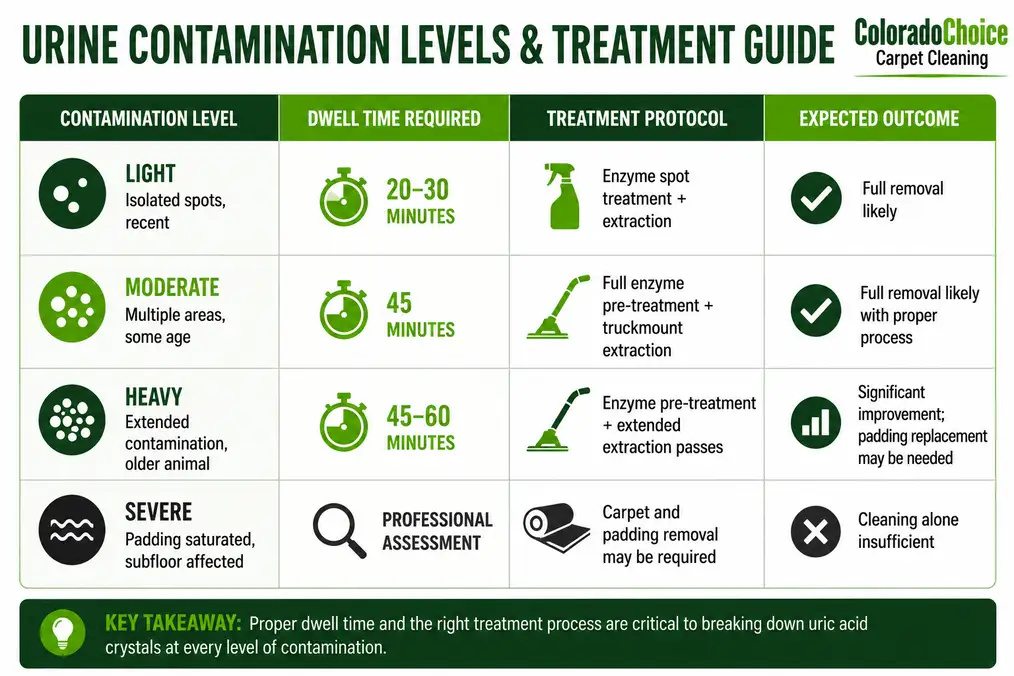
Source: IICRC S100 Standard and Reference Guide for Professional Carpet Cleaning — pet urine contamination classification and treatment depth requirements.
If you're in Castle Rock and dealing with pet urine in older carpet, our Castle Rock carpet cleaning team works out of two trucks for exactly the reasons described above.
